Tag: Donald Trump

  • Business and pleasure on menu for Macron’s second day in US

    A sit-down between President Donald Trump and French President Emmanuel Macron followed by a joint news conference highlight the business portion of the French leader’s second day in Washington.

    WASHINGTON (AP) – A sit-down between President Donald Trump and French President Emmanuel Macron followed by a joint news conference highlight the business portion of the French leader’s second day in Washington.

    The pageantry of Macron’s official state visit, the first of the Trump presidency, comes Tuesday night with a lavish state dinner at the White House. About 150 guests are expected to dine on rack of lamb and nectarine tart and enjoy an after-dinner performance by the Washington National Opera.

    Monday night was more relaxed, featuring a helicopter tour of Washington landmarks and a trip to the Potomac River home of George Washington with their wives for dinner. The presidents and their spouses hopped on a helicopter bound for Mount Vernon, Washington’s historic riverside home, for a private dinner one night before the leaders sit down for talks on a weighty agenda including security, trade and the Iran nuclear deal.

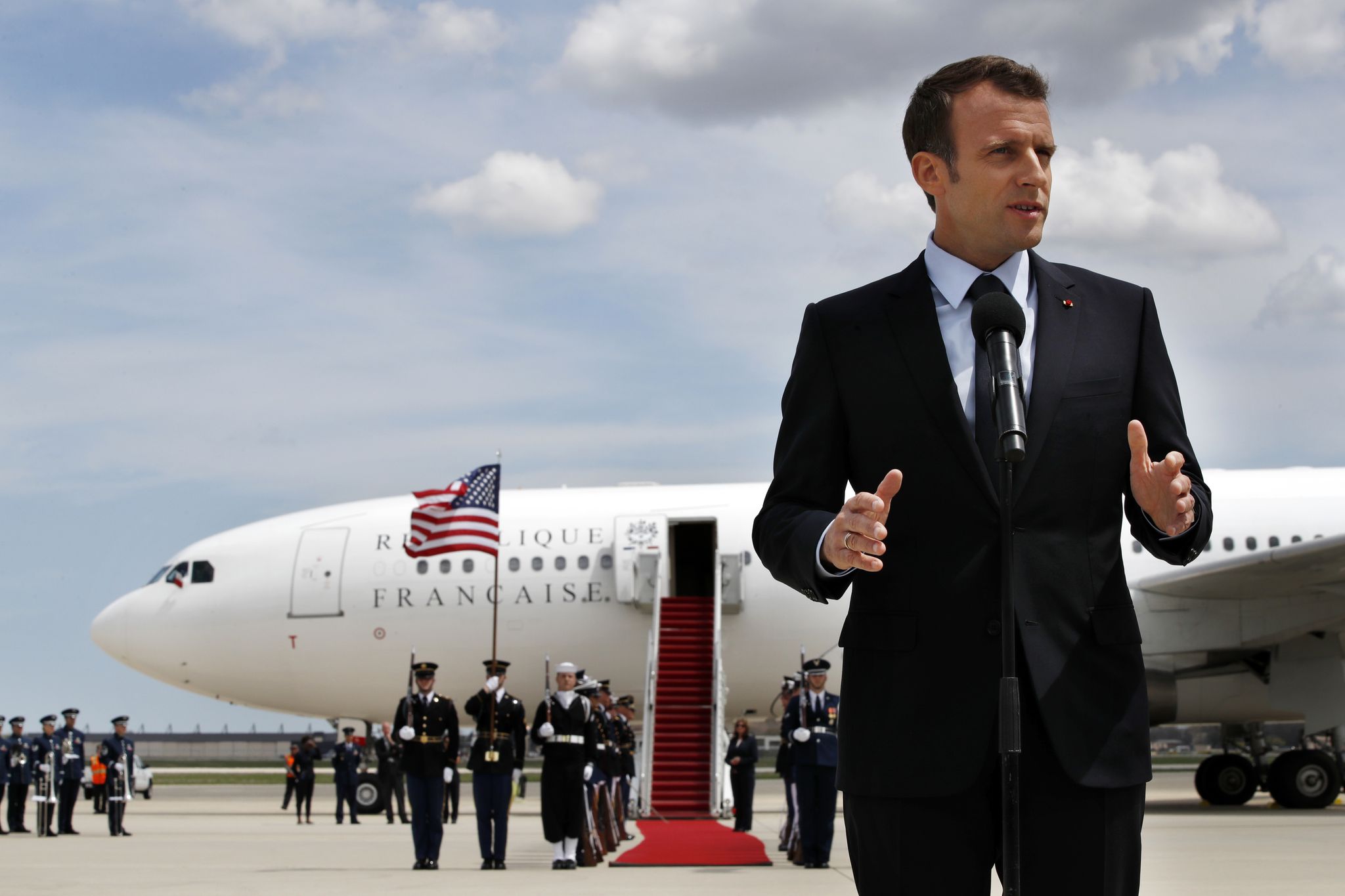
    “This is a great honor and I think a very important state visit given the moment of our current environment,” Macron said Monday after his plane landed at a U.S. military base near Washington.

    Macron’s pomp-filled three-day state visit to Washington underscores the importance that both sides attach to the relationship: Macron, who calls Trump often, has emerged as something of a “Trump whisperer” at a time when the American president’s relationships with other European leaders are more strained. Trump, who attaches great importance to the optics of pageantry and ceremony, chose to honor Macron with the first state visit of his administration as he woos the French president.

    For all their camaraderie, Macron and Trump disagree on some fundamental issues, including the multinational nuclear deal, which is aimed at restricting Iran’s development of nuclear weapons. Trump, skeptical of the pact’s effectiveness, has been eager to pull out as a May 12 deadline nears. Macron says he is not satisfied with the situation in Iran and thinks the agreement is imperfect, but he has argued for the U.S. sticking with the deal on the grounds that there is not yet a “Plan B.”

    The Trumps and Macrons helped plant a tree on the White House grounds together before boarding Trump’s Marine One helicopter for a scenic tour of monuments built in the capital city designed by French-born Pierre L’Enfant as they flew south to Mount Vernon, the first U.S. president’s home along the Potomac River.

    The young oak is an environmentally friendly gift to the White House from Macron, and one that also bears historical significance. It sprouted at a World War I site in France, the Battle of Belleau Wood, that became part of U.S. Marine Corps lore.

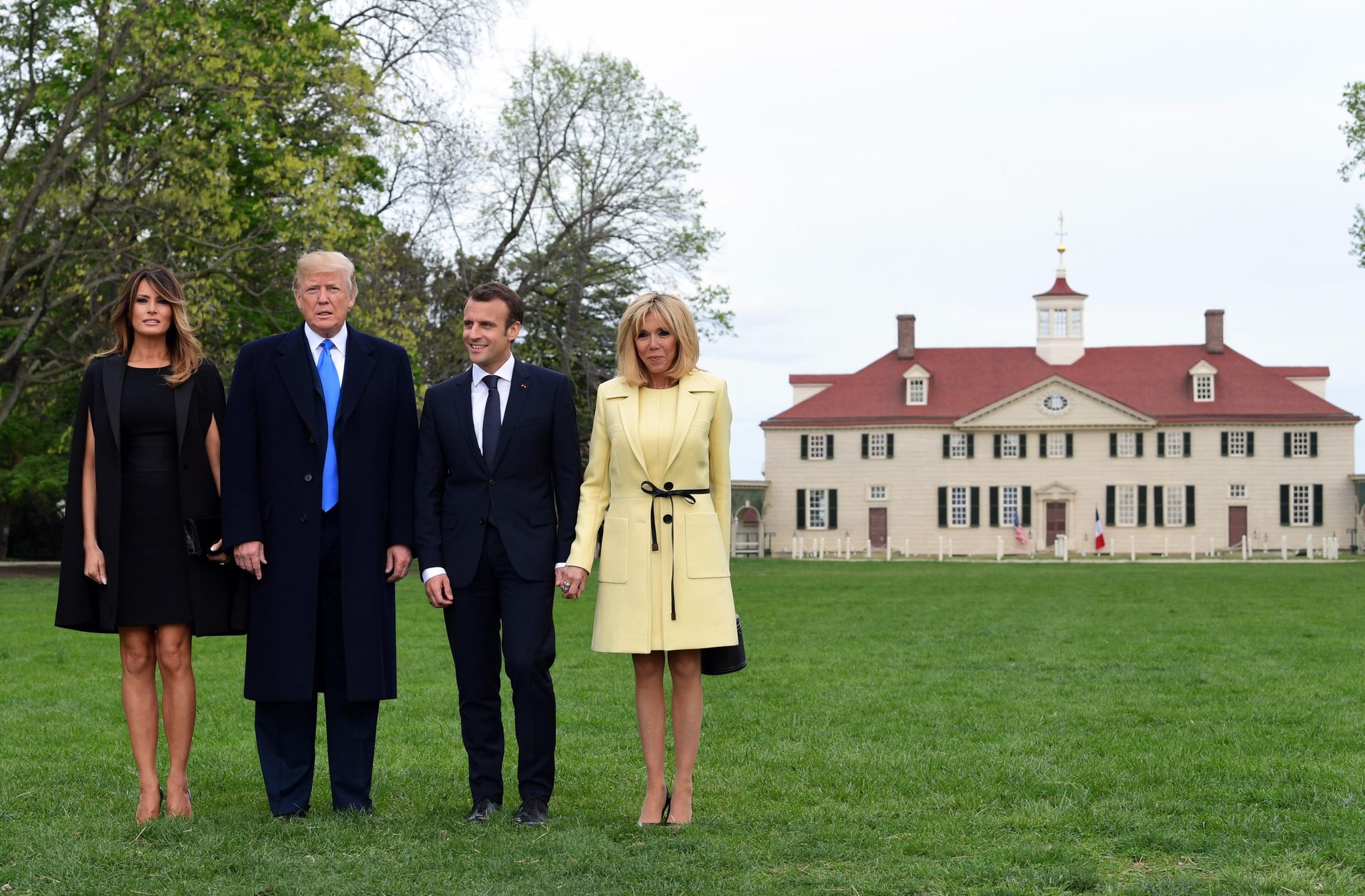
    After Trump’s helicopter landed at Mount Vernon, the two presidents, each holding his wife’s hand, walked a short distance and posed for pictures before they boarded golf carts that ferried them to the front door of Washington’s plantation house. The couples were led on a brief outdoor tour before they entered the pale yellow building for dinner of Dover sole, pasta stuffed with lemon ricotta, and chocolate souffle and cherry vanilla ice cream.

    Trump declared the dinner “really fantastic” before returning to the White House.

    He ended his first year in office without receiving a foreign leader on a state visit, the first president in nearly 100 years to fail to do so. He was Macron’s guest last July at the annual Bastille Day military parade in the center of Paris. Macron and his wife also took Trump and America’s first lady on a tour of Napoleon’s tomb and whisked them up in the Eiffel Tower for dinner overlooking the City of Light.

    Macron will be welcomed back to the White House on Tuesday with a traditional arrival ceremony featuring nearly 500 members of the U.S. military and a booming 21-gun salute. The state visit also offers Macron his first Oval Office sit-down with Trump and a joint White House news conference. There’s also a State Department lunch hosted by Vice President Mike Pence.

    The French president’s White House day will be capped Tuesday night with a state dinner, the highest social tribute a president bestows on an ally and partner.

    Melania Trump played an active role in every detail of the visit, said White House spokeswoman Sarah Huckabee Sanders.

    The first lady settled on a state dinner menu of rack of lamb and nectarine tart, along with after-dinner entertainment provided by the Washington National Opera for about 150 guests. On Monday, she released details of the glitzy affair being planned to dazzle Macron and his wife, Brigitte.

    Dinner will be served in the State Dining Room, which will feature more than 2,500 stems of white sweet pea flowers and nearly 1,000 stems of white lilac. Separately, more than 1,200 branches of cherry blossoms will adorn the majestic Cross Hall.

    The first lady opted for a cream-and-gold color scheme, and will use a mix of china services from the presidencies of Bill Clinton and George W. Bush.

    State dinner tickets are highly sought after by Washington’s political and business elite. A few of those expected to attend: Christine Lagarde, head of the International Monetary Fund and a former top French government official; House Speaker Paul Ryan, R-Wis.; Treasury Secretary Steven Mnuchin and his wife, Louise Linton; Defense Secretary Jim Mattis, Sen. Bill Cassidy, R-La., and Mike Pompeo, Trump’s choice to be the next secretary of state.

    In a break with tradition, Trump has invited no congressional Democrats or journalists, said a White House official who was not authorized to discuss the arrangements publicly. But some Democrats did make the cut, including Louisiana Gov. John Bel Edwards, whose office confirmed his attendance.

    ___

    Follow Darlene Superville on Twitter: http://www.twitter.com/dsupervilleap

  • US won’t ease sanctions without action by NKorea on nukes

    The White House said Monday North Korea won’t get sanctions relief until it takes “concrete action” toward denuclearization, the goal of President Donald Trump’s planned summit with Kim Jong Un.

    WASHINGTON (AP) – The White House said Monday North Korea won’t get sanctions relief until it takes “concrete action” toward denuclearization, the goal of President Donald Trump’s planned summit with Kim Jong Un.

    Press secretary Sarah Huckabee Sanders’ comments appeared to leave open the possibility of easing the U.S.-led “maximum pressure” campaign before North Korea had completely given up its nuclear weapons.

    But Sanders said the U.S. wouldn’t make the mistake of past administrations in taking the North Koreans “simply at their word.” She said, “We’ve seen some steps in the right direction but we have a long way to go.”

    On Saturday, North Korea announced it will close its nuclear testing facility and suspend nuclear and intercontinental ballistic missile tests – a move welcomed by Trump as “big progress.” The North stopped short of suggesting it will give up its nuclear weapons or scale back its production of missiles and their related components.

    Asked if the suspension of tests was a positive sign, Defense Secretary Jim Mattis said Monday, “Right now, I think there (are) a lot of reasons for optimism that the negotiations will be fruitful and we’ll see.”

    This Friday, U.S.-allied South Korean President Moon Jae-in and Kim will hold a summit in the demilitarized zone between the Koreas that could lay the ground for Trump’s planned meeting with the North Korean dictator in May or early June. The leaders of the U.S. and North Korea have never met during six decades of hostility since the Korean War.

    Sanders said the U.S. goal was the complete denuclearization of the Korean Peninsula. When asked if the president was willing to accept anything short of that goal before lifting sanctions or was willing to go incrementally, she told reporters: “Certainly no sanctions lifted until we see concrete actions taken by North Korea to denuclearize.”

    Last year, the U.S. spearheaded through the U.N. Security Council the toughest international sanctions yet against North Korea in response to three long-range missile launches and its most powerful nuclear test explosion yet. The Trump administration supplemented those restrictions with unilateral U.S. sanctions against firms that had conducted illicit trade with the North.

    This year, Kim has pivoted from confrontation to diplomacy and, according to South Korea and China, has expressed a commitment to denuclearization. There is still uncertainty about what he seeks in return.

    Three weeks ago, Trump’s pick to be the next secretary of state, CIA Director Mike Pompeo, became the most senior U.S. official to travel to North Korea in nearly two decades, but the content of his discussions with Kim has not been made public.

    The last nuclear talks between the U.S. and North Korea collapsed in 2012. The two nations also remain in a technical state of war as the 1950-53 Korean War ended with an armistice not a peace treaty.

  • Trump firmly against Iran nuke deal, ready for French President Macron’s pro-deal pitch

    President Trump isn’t backing off his opposition to the Iran nuclear deal, the White House said Monday of the international agreement that is expected to be a top issue during the state visit by Frenc

    President Trump isn’t backing off his opposition to the Iran nuclear deal, the White House said Monday of the international agreement that is expected to be a top issue during the state visit by French President Emmanuel Macron.

    Mr. Trump has threatened to pull out of the Obama-era deal. Mr. Macron and others, including Iranian officials, have urged him to reconsider.

    “The president has been extremely clear that he thinks it is a bad deal. That certainly hasn’t changed,” said White House press secretary Sarah Huckabee Sanders.

    Mr. Trump can nix the deal May 12, when he has the choice whether to extend sanctions relief under the deal or reimpose sanctions on Iran.

    Still, Ms. Sanders said the president always welcomed discussions about making deals that he thinks would benefit the American people.

    “I’m confident we have a great negotiator at the table,” she said, adding that her statement did not discount Mr. Macron’s negotiating skills.

    The president is hosting Mr. Macron in the first state visit of the Trump administration, with three days of events that begin Monday and include a state dinner Tuesday.

  • Kim Jong-un summit threatened by Trump’s bid to end Iran nuclear deal

    President Trump’s determination to undermine the Iran nuclear deal could undercut his hopes for quick success in the upcoming summit with North Korean leader Kim Jong-un, many in South Korea fear.

    SEOUL — President Trump’s determination to undermine the Iran nuclear deal could undercut his hopes for quick success in the upcoming summit with North Korean leader Kim Jong-un, many in South Korea fear.

    Former high-level South Korean officials and analysts say Mr. Kim will be far less likely to abandon his nuclear and missile programs if the U.S. pulls out of the 2015 multilateral agreement meant to curb Tehran’s nuclear programs in exchange for relief from international economic sanctions.

    Mr. Kim plans a one-on-one summit with South Korean President Moon Jae-in on April 27 and is set to meet Mr. Trump next month or in early June at a still-to-be-determined location. The Trump administration has said the goal of the high-risk meeting will be to get the North to agree to eventually give up its nuclear programs.

    But the prospect of a U.S. pullout from the Iran deal casts a shadow over the talks.

    “It will have a very negative influence on North Korea’s decision of whether or not to come out with a strong denuclearization statement or to make any serious concessions during a summit with President Trump,” said Paik Hak-soon, a top North Korea analyst with the Sejong Institute think tank in the South.

    The Iran agreement and the Korean Peninsula talks “are quite closely connected in the perception of the North Korean leadership,” Mr. Paik said in an interview. “Trashing the Iran deal will have a very souring effect.”

    Many here see Mr. Trump’s appointment of John R. Bolton as his national security adviser, a sharp critic of the Obama administration’s Iran deal and a past proponent of regime change in Iran, as an indication that Washington is bent on pulling fully out of the accord.

    Under the Iran deal’s terms, U.S., China, Russia, Britain and France gave billions of dollars in sanctions relief to Iran in exchange for sharp curbs and intrusive inspections of Tehran’s nuclear programs.

    Other signatories to the deal say they want to preserve it, but Iranian officials have said they will not be bound by the nuclear restrictions if the U.S. says it no longer is part of the agreement.

    Mr. Trump decertified the Iran deal as in the U.S. national interest in October — a mainly rhetorical step that sets the stage for a full withdrawal. Critics of the agreement say Iran has violated the letter and the spirit of the deal by testing a string of long-range ballistic missiles and continuing to threaten Israel and U.S. Sunni Arab allies in the region through a network of proxy forces such as Lebanon’s Hezbollah.

    The president has issued an ultimatum to Britain, France and Germany. If they don’t join Washington in fixing “terrible flaws” in the deal, Mr. Trump said, he will move to unilaterally reimpose U.S. sanctions on Iran by May 12, the next deadline for him to renew sanctions relief that Washington has been giving Iran for the past three years. There has been little indication of progress on a revised deal with exactly a month to go.

    State Department Policy Planning Director Brian Hook told reporters last month that the goal is to get the Europeans to agree to collective new sanctions against Iran if it tests long-range missiles or evades inspections of its remaining nuclear facilities.

    Echoes across Asia

    But the Iran debate is having clear echoes on the other side of Asia as Mr. Trump pursues his “deal on the de-nuking of North Korea.”

    “I see a very close correlation with the Iran agreement, and I am concerned that if the agreement is not [upheld], it will have an impact on the nuclear issue on the Korean Peninsula,” said retired South Korean Army Lt. Gen. Chun In-bum, an analyst on the North Korean threat.

    “It’s going to make the negotiations between the United States and North Korea more difficult,” said Jun Bong-geun, the head of security and unification studies at the Korea National Diplomatic Academy in Seoul. “North Korea may want more assurances from Washington, and they may want to hide more.

    “It might send a message that if changing administrations can change a deal, what does that mean for [Pyongyang]? It will probably make it harder for the North Koreans to trust a deal with the U.S.,” Gen. Chun said in an interview.

    The Moon government has remained mum on the Iran issue, but one former official told The Times that there “definitely is concern” inside the administration.

    Given the skepticism Mr. Trump and his advisers have about Iran’s compliance, the bar may be even higher for Mr. Kim. U.S. security officials say North Korea has routinely violated international accords meant to stop it from obtaining nuclear weapons and the missiles to hit the U.S. and its East Asian allies.

    The Trump administration has indicated that denuclearization — not just a declaration by Pyongyang but verifiable abandonment of the nuclear program — is a precondition for negotiations toward lifting sanctions on North Korea.

    Uncertainty looms, however, over the administration’s game plan for the Trump-Kim summit.

    Just days after he was appointed as national security adviser last month, Mr. Bolton told Radio Free Asia that the administration should follow the “Libyan Model” with North Korea. The George W. Bush administration struck a relatively quick deal in December 2003 with Libyan dictator Moammar Gadhafi to give up his nuclear materials in exchange for sanctions relief and the promise of normalized relations with the West.

    But South Korean sources say the mention of Libya likely angered Pyongyang, which has long pointed to Gadhafi’s death at the hands of U.S.-backed rebels during the 2011 Arab Spring as an example of why a smaller state should never surrender its nuclear arsenal.

    “We all know the Gadhafi case is something the North Koreans point to repeatedly to demonstrate that their behavior will not be decided by anybody, let alone by the United States, the way Gadhafi’s was,” said Mr. Paik. “And I think you can compare the collapse of the Iran deal, if America pulls out of it, to the Gadhafi case.”

    If Mr. Trump keeps the U.S. in the Iran deal, however, “the North Koreans could more comfortably come to the table with the United States.”

    “Bolton clearly has a very narrow view of the Libya case,” said the former official, who spoke on background with The Times, arguing that the U.S.-Libya detente in 2006 depended heavily on the involvement of Britain as an intermediary and that no such intermediary exists vis-a-vis the potential U.S.-North Korean negotiations.

    The uncertainty, many here say, means that the fate of any Trump-Kim summit will depend heavily on what comes from a summit between Mr. Kim and Mr. Moon.

    Mr. Paik believes one of Mr. Moon’s goals may be to get such a statement from Mr. Kim on denuclearization. At a minimum, he said, Mr. Moon is “trying to persuade Kim Jong-un with maximum effort to keep his commitment to denuclearize when he comes to the U.S.-North Korea summit talks.”

  • Donald Trump no longer an honorary Cossack

    Some Russians aren’t sitting back as they await President Trump’s promised strike via Twitter on their Syrian ally over a suspected chemical weapons attack.

    Some Russians aren’t sitting back as they await President Trump’s promised strike via Twitter on their Syrian ally over a suspected chemical weapons attack.

    The Irbis Cossacks, the St. Petersburg branch of the legendary Russian warrior clan, announced Wednesday it was stripping Mr. Trump of his status as an “honorary Cossack” and now say they will burn the American president in effigy for his menacing words.

    Andrei Polyakov, the ataman, or leader, of the Irbis Cossacks, told the Russian news website Rosbalt.ru that the move was made because of Mr. Trump’s “insults against the state, which cannot be tolerated.”

    The group first offered Mr. Trump honorary membership shortly after his 2016 election, citing his comments questioning the value of the NATO alliance and seeking to repair frayed U.S.-Russian ties. The relationship persisted despite the U.S. airstrikes Mr. Trump ordered in 2017 against a Syrian airbase over a previous suspected use of chemical weapons.

    “Political events began to unfold not as pleasantly as we’d like,” Ataman Polyakov told the website, according to The Moscow Times. “Realizing that we were mistaken, we made a decision to demote Trump and expel him from the organization in disgrace.”

    The Rosbalt account can be found here.

  • praised for Russian sanctions

    U.S. lawmakers on Sunday applauded the Trump administration’s most recent move to sanction Russian oligarchs for the country’s “malign” influence around the globe and said the economic pressure is esp

    U.S. lawmakers on Sunday applauded the Trump administration’s most recent move to sanction Russian oligarchs for the country’s “malign” influence around the globe and said the economic pressure is especially important now in the wake of an apparent chemical attack in Syria — a key Russian ally.

    Sen. Benjamin L. Cardin, Maryland Democrat, said that although the president could have acted faster on the sanctions, the targeting of oligarchs was “very important.”

    “I really applaud the people in the State Department and in Treasury for taking this action,” said Mr. Cardin, his party’s ranking member on the Senate Foreign Relations Committee.

    The Trump administration Friday slapped sanctions on Russian senior officials, oligarchs and the companies they own, going after those closest to President Vladimir Putin to punish Moscow’s activities around the world.

    In a significant escalation of the sanctions, President Trump targeted oligarchs and companies in the energy sector, which is the lifeblood of the Russian economy.

    Sen. Susan M. Collins, Maine Republican, said that stepping up pressure on Russia is particularly important after images shot around the world of a suspected chemical weapons attack that killed dozens of people in Syria over the weekend.

    Russia is a key ally of Syrian President Bashar Assad, whose government has been battling rebel forces in a bloody civil war in the country for seven years.

    “Last time this happened, the president did a targeted attack to take out some of the facilities — that may be an option that we should consider now,” Ms. Collins said on CNN’s “State of the Union.”

    “But it is further reason why it is so important that the president ramp up the pressure and the sanctions on the Russian government, because, without the support of Russia, I do not believe that Assad would still be in office,” she said.

    The sanctions also hit Mr. Putin’s son-in-law, who became a major energy sector player after marrying into the Putin family.

    The sanctions froze all assets for seven Russian oligarchs and 12 companies they own or control, 17 senior Russian government officials, and a state-owned Russian weapons trading company and its banking subsidiary.

    The Trump administration said the sanctions are intended to punish Russian oligarchs and elites who profit from the country’s “corrupt” system.

    They follow sanctions on Russian officials and expulsions of 60 Russian diplomats last month over Moscow’s nerve agent assassination attempt in Britain on a former Russian double agent and his daughter.

    The U.S. now has hit around 200 Russian individuals and entities with various sanctions.

    The latest sanctions brought a swift condemnation from senior Russian officials, who accused the Trump administration of lashing out to mask America’s own mounting problems.

    The Russian Foreign Ministry is looking at possible responses to the sanctions, said spokeswoman Maria Zakharova.

    “The response will be given. We always do it. We have drawn an entire list of possible measures we are looking at,” she said, according to the state-owned Tass news agency.

    “It has nothing to do with some virtual meddling with elections, it has nothing to do with either Crimea or Ukraine. It is a strategy, a knock-down-Russia game,” Ms. Zakharova said Sunday in an interview on Rossiya-1 TV.

    Before the sanctions were officially announced, Kremlin spokesman Dmitry Peskov called the phrase “Russian oligarchs” inappropriate.

    “It’s been a long time since Russia had oligarchs. There are no oligarchs in Russia,” he said, according to The Moscow Times.

    Mr. Trump, dogged by special counsel Robert Mueller’s Russia investigation, also has struggled to shake the perception that he is soft on Mr. Putin, though he did criticize the Russian president by name on Sunday for supporting the Assad regime.

    “President Putin, Russia and Iran are responsible for backing Animal Assad,” the president tweeted.

    Mr. Cardin said on CBS’s “Face the Nation” that he was pleased by the president’s Syria tweets. He said the specific mention of Mr. Putin’s name was a significant change for Mr. Trump.

    “He has not done that in regards to the sanctions imposed against the oligarchs. And he certainly has not done that in regards to Mr. Putin’s interference in our own country,” Mr. Cardin said.

    The administration would not say why Mr. Putin was not included on the sanctions list but stressed that he would feel the impact.

    “This will be noticed far and wide,” said a senior administration official.

    The Treasury has been preparing the sanctions for a long time, and they are directed at the “full range of Russian activities,” said another senior official.

    The official said the moves are not a direct response to the recent assassination attempt in Britain, which triggered punitive action from governments around the world.

  • Donald Trump hits China with $60 billion in tariffs

    President Trump signed an order Thursday that cracked down on China’s unfair trade practices and theft of U.S. intellectual property with $60 billion in tariffs on high-tech imports.

    President Trump socked China with up to $60 billion in proposed trade tariffs, investment restrictions and plans for a formal complaint to the World Trade Organization, drawing immediate threats of retaliation from Beijing and sending the stock market into an epic nosedive Thursday over fears that the globe’s two biggest economies were heading for a trade war.

    Following though on the tough talk on trade that helped put him in the White House, Mr. Trump said the U.S. was finally cracking down on decades of unfair trade practices and theft of intellectual property. U.S. officials say these Chinese practices contributed to bilateral trade deficits for the U.S. of hundreds of billions of dollars annually.

    “We are doing things for this country that should have been done for many, many years,” the president said as he signed an order for tariffs and other get-tough measures on China.

    In comments that unnerved investors, Mr. Trump added, “This is the first of many.”

    The tariffs instruct the Commerce Department to target Chinese information technology, consumer electronics and telecoms, imposing import costs of $50 billion to $60 billion that roughly equal the value of U.S. technology lost to China because of the country’s onerous trade rules.

    China vowed retaliation.

    “China is not afraid of and will not recoil from a trade war,” the Chinese Embassy in Washington said in a statement. It said Mr. Trump’s tariffs would backfire and “directly harm the interests of U.S. consumers, companies, and financial markets.”

    Despite its huge surpluses, China is not without weapons in a trade fight. Beijing has signaled that it could strike back by cutting its soybean purchases from U.S. farmers. China is the biggest market for soybeans and many other U.S. agricultural products and is a crucial market for American aircraft, cotton, electrical machinery, cars and trucks, corn and coal.

    China is also the world’s largest holder of U.S. government debt — a double-edged sword as any move to hurt U.S. government credit could undercut the value of Beijing’s holdings as well.

    The sell-off on Wall Street was deep and immediate. All 30 stocks in the Dow Jones lost ground, and investment safe havens such as gold and U.S. Treasury bonds jumped in value.

    The Dow Jones industrial average tumbled more than 724 points, or 2.93 percent, to fall below the 24,000 mark. The broader S&P 500 slipped more than 68 points, or 2.52 percent, and the Nasdaq fell more than 178 points, or 2.43 percent.

    It was the worst day for the Dow since a chaotic sell-off in February and the blue chip index’s worst March free fall in 17 years.

    “If the Dow is allowed to vote, you can see what their vote is today: They don’t like it,” Rick Helfenbein, president of American Apparel & Footwear Association, said on Fox Business Network.

    Like many U.S. industries still in the dark on where exactly the Trump administration’s tariffs will land, Mr. Helfenbein said he hoped the tariffs wouldn’t hit his sector.

    Trade moves

    The China decision came close on the heels of a string of other trade moves to implement Mr. Trump’s “America first” economic agenda and reverse what he sees as decades of misguided U.S. trade policy promoting open markets and multilateral trade agreements.

    The administration announced tariffs on steel and aluminum imports this month, although a number of markets, including Canada, Mexico, the European Union, South Korea and Australia, will be exempted initially from the tariffs. Mr. Trump since the beginning of the year has put tariffs on Chinese solar panels and South Korean washing machines. A week later, China’s biggest maker of solar panels announced plans to open a U.S. factory.

    The U.S. is also locked in lengthy talks with Canada and Mexico over Mr. Trump’s demand for a renegotiation of the North American Free Trade Agreement. The president has vowed to leave the 24-year-old pact if a new agreement is not reached.

    Commerce Secretary Wilbur L. Ross Jr., a prime advocate of the tariffs, acknowledged that China was likely to retaliate against American companies.

    Many expect Beijing to target states where the president is most popular, but Mr. Ross played down the prospect of an all-out trade war.

    “We will end up negotiating these things rather than fighting over them, in my view,” Mr. Ross told Bloomberg News.

    With U.S. companies long complaining about China’s failure to protect foreign investors’ intellectual property rights, the president’s order focused on technology imports. But the list of items subject to the tariff could expand to include such items as clothing and shoes.

    The tariffs are being imposed under Section 301 of the Trade Act of 1974 that authorizes the president to take action or retaliation against unjustified, unreasonable or discriminatory foreign trade laws that hurt U.S. commerce. They are part of a package of measures to combat Beijing’s aggressive trade tactics, including forced intellectual property transfers for U.S. companies as the price of doing business in China.

    The actions included:

    ⦁ Adding 25 percent to tariffs on products supported by China’s unfair industrial policy, including aerospace, cellphones, computers and machinery.

    ⦁ Opening a World Trade Organization case against China’s discriminatory technology licensing practices.

    ⦁ New restrictions on Chinese companies buying into U.S. technology business.

    At the White House signing ceremony, Mr. Trump was surrounded by former top national security officials and CEOs from defense companies Raytheon, Lockheed Martin, General Atomics and Leidos.

    Lockheed Martin CEO Marillyn Hewson called it a “very important moment for our country.”

    “We are addressing what is a critical area for the aerospace and defense industry, and that is protecting our intellectual property,” she said. “That is the lifeblood of our companies. And so we very much welcome this action on the part of the Trump administration and the president of the United States.”

    Corporate angst

    U.S. Trade Representative Robert Lighthizer, who spearheaded the action against China, said the Trump administration was moving to protect America’s future.

    “Technology is really the backbone of the future of the U.S. economy,” he said.

    Still, leaders from many business sectors overwhelmingly opposed the tariffs and warned that it would be a tax ultimately paid by U.S. consumers.

    “The internet industry has serious concerns with the impact of these tariffs — and potential retaliatory actions — on American jobs, consumers, and the digital economy,” said Melika Carroll of the Internet Association, an industry lobbying group.

    The Business Roundtable, an association of CEOs from the biggest U.S. companies, said in a statement that the Trump tariffs “will only raise prices in America, make American companies and products less competitive, and harm U.S. workers and consumers.”

    Mr. Trump brushed aside the concerns.

    Emphasizing that America’s $800 billion trade deficit with the world could not be allowed to continue, Mr. Trump said other trading partners such as South Korea and the European Union were begging to make deals in the face of his tough trade policies.

    The U.S. trade deficit with China topped $375 billion last year, but Mr. Trump cited calculations that put it over $500 billion.

    He said the tariffs, which do not take effect immediately, had already brought Beijing to the negotiating table. Since taking office, Mr. Trump has been pressing Chinese President Xi Jinping and other top officials to rein in unfair trade restrictions and lower the trade deficit by $100 billion.

    “We are in the midst of very major and very positive negotiations,” the president said.

    But pulling the trigger on tariffs could pressure Mr. Xi to respond at least as hard to show his own government that he can’t be bullied.

  • Donald Trump, Texas sanctuary city fight backed by appeals court

    States have the power to punish sanctuary cities within their borders and to force local police and sheriff’s departments to cooperate in turning illegal immigrants over to the federal government for

    States have the power to punish sanctuary cities within their borders and to force local police and sheriff’s departments to cooperate in turning over illegal immigrants to the federal government for deportation, an appeals court ruled Tuesday in upholding a Texas law.

    The 3-0 decision by a panel of the 5th U.S. Circuit Court of Appeals marks a major victory for President Trump, who has demanded punishment for sanctuary cities that thwart the federal government to protect illegal immigrants.

    The judges didn’t go that far, but they did say the federal government’s detainer requests, which ask local governments to hold illegal immigrants for pickup, are legal. Localities can refuse based on their own resources, the court ruled — but the detainer requests are legal, the judges said.

    Texas Gov. Greg Abbott, a Republican, praised the ruling.

    “Law is in effect,” he said on Twitter.

    Known as SB4, the legislation Mr. Abbott signed last year requires police to determine the legal status of those they encounter during their duties.

    The law also punished local elected officials, police chiefs and other law enforcement leaders who enacted or carried out sanctuary policies that refused cooperation with U.S. Immigration and Customs Enforcement.

    The law explicitly said local jurisdictions should comply with detainer requests.

    Immigrant rights advocates and a number of Texas cities objected. They said detainers forced state or local police to hold illegal immigrants beyond their usual release time, infringing on their Fourth Amendment rights.

    But Judge Edith H. Jones, writing the court’s opinion, said it’s not clear that illegal immigrants are covered by the Fourth Amendment. Beyond that, she said, federal detainer requests are legitimate.

    She said that under the Trump administration’s policy, ICE officers must issue administrative warrants to accompany their detainer requests. Those warrants serve as statements of probable cause that local police can rely on to hold someone — just as they would do for any other police officer who makes a valid request.

    “Here the ICE-detainer mandate itself authorizes and requires state officers to carry out federal detention requests,” Judge Jones wrote.

    The court did rule part of Texas’ law that prohibited local elected officials from endorsing sanctuary policies to be problematic because it could be seen as an infringement on the officials’ free speech rights. But she said the state can prevent a locality from adopting or enforcing a sanctuary policy and can impose penalties on officials who attempt to create sanctuaries.

    Sanctuary cities are jurisdictions that have policies limiting or, in their more extreme forms, thwarting cooperation with ICE deportation efforts.

    The Obama administration opposed sanctuary cities, but Mr. Trump took that policy to a new level by going to war with sanctuaries, particularly in California.

    His administration filed a lawsuit last week challenging three California sanctuary laws. On Tuesday, Mr. Trump — while visiting San Diego to tour prototypes of his border wall — said he wants Congress to strip federal grant money from sanctuaries in the upcoming spending bill.

    Mr. Trump’s threats have been unpersuasive. The number of sanctuaries has expanded dramatically during his first 14 months in office.

    Texas, however, had been a rare bright spot for the Trump administration. State officials have moved to back him up in opposing sanctuaries.

    SB4 had been slated to go into effect Sept. 1, just days after a federal district judge issued a broad injunction.

    Judge Orlando Garcia asserted that the law would erode trust between police and immigrant communities, making them less safe.

    “The mandates, penalties and exacting punishments under SB4 upset the delicate balance between federal enforcement and local cooperation and violate the United States Constitution,” Judge Garcia wrote.

    The 5th Circuit last year quickly stayed much of Judge Garcia’s blockade, and Tuesday’s ruling was an even bigger spanking for the Clinton-appointed judge.

    Lee Gelernt, an American Civil Liberties Union lawyer who appeared before the 5th Circuit during oral arguments, said the court did leave open the possibility that Texas law could be illegal as it was carried out.

    “We are exploring all legal options going forward. The court made clear that we remain free to challenge the manner in which the law is implemented, so we will be monitoring the situation on the ground closely,” he said.

    He said localities can still object to detainer requests based on a lack of resources or other nonimmigration restraints.

    Andre Segura, legal director of the ACLU of Texas, said illegal immigrants still have the right to remain silent when questioned about their immigration status.

  • Donald Trump inches closer to blaming Russia for poisoning ex-spy in the U.K.

    President Trump said Tuesday that he was prepared to condemn Russia for the poisoning of a ex-British spy in the U.K., but he still wanted to have all the facts.

    President Trump said Tuesday that he was prepared to condemn Russia for the poisoning of a ex-British spy in the U.K., but he still wanted to have all the facts.

    A day earlier, the White House resisted blaming Russia for the attack despite British Prime Minister Theresa May saying it was “highly likely” that Moscow was behind the assassination attempt.

    “It sounds to me like it would be Russia based on all the evidence they have. I don’t know if they have come to a conclusion,” Mr. Trump said Tuesday.

    SEE ALSO: Trump ousts Tillerson, taps CIA Director Pompeo for State Dept.

    The president said that he planed to speak later in the day with Mrs. May.

    “As soon as we get the facts straight, if we agree with them, we will condemn Russia or whoever it may be,” Mr. Trump told reporters Tuesday.

    Former Russian intelligence officer Sergei Skripal, 66, and his daughter, Yulia Scribal, 33, were found collapsed on a city bench March 4 in Salisbury, England. They had been exposed to a military-grade nerve agents known as Novichok, according to British authorities.

    Mr. Skripal and his daughter remain in a critical but stable condition in the hospital.

    In 2004, Mr Skripal was convicted by the Russian government of spying for MI6. He was released to the U.K. in a spy swap in 2010.

    The White House resistance to blaming Russia was the final split between Mr. Trump and former Secretary of State Rex W. Tillerson, whose ouster was announced Monday.

    Mr. Tillerson said that Russia was “clearly” behind the poisoning.

  • Trump says North Korea won’t test missiles before his meeting with Kim Jong Un

    President Trump said Saturday he’s counting on North Korea to refrain from any missile tests while he prepares for his first face-to-face meeting with North Korean leader Kim Jong-un.

    President Trump said Saturday he’s counting on North Korea to refrain from any missile tests while he prepares for his first face-to-face meeting with North Korean leader Kim Jong-un.

    Departing the White House for a campaign rally in Pennsylvania, Mr. Trump predicted “tremendous success” with his pending diplomacy in Asia.

    “I think North Korea is going to go very well,” the president told reporters. “I think this is going to be something very successful. We have a lot of support. The promise is they wouldn’t be shooting off missiles in the meantime, and they’re looking to de-nuke. So that’d be great.”

    Earlier, the president said on Twitter that he trusts Pyongyang to keep its commitments against provocation leading up to the talks.

    “North Korea has not conducted a Missile Test since November 28, 2017 and has promised not to do so through our meetings. I believe they will honor that commitment!” Mr. Trump tweeted.

    Pyongyang claimed after its most recent missile test in November that it has a new rocket capable of striking anywhere on the U.S. mainland, and declared itself a “complete” nuclear state.

    Earlier Saturday, Mr. Trump said that China’s president is pleased that Mr. Trump is pursuing diplomacy with North Korea instead of “the ominous alternative.”

    “Chinese President XI JINPING and I spoke at length about the meeting with KIM JONG UN of North Korea,” Mr. Trump tweeted about their phone call a day earlier. “President XI told me he appreciates that the U.S. is working to solve the problem diplomatically rather than going with the ominous alternative. China continues to be helpful!”

    Mr. Trump, who vowed last year to rain “fire and fury” on North Korea if it attacks the U.S., accepted an invitation from Mr. Kim to meet for talks within the next two months. The date and location haven’t been set.

    Chinese state media said Mr. Xi applauded the move by Mr. Trump as a “positive gesture.”

    “We hope that all relevant parties can make positive gestures and refrain from actions that prevent the situation on the Korean peninsula from calming down,” Mr. Xi was quoted as saying on state-run broadcaster CCTV.

    The White House said Friday that North Korea must demonstrate “concrete steps” toward denuclearization before the talks can go forward.

    China is North Korea’s most important trading partner. The president has been pushing Mr. Xi to exert more economic and diplomatic pressure on North Korea to scale back its nuclear weapons and ballistic missile programs.

    Mr. Trump also said that Japanese Prime Minister Shinzo Abe, with whom he spoke on Thursday, “is very enthusiastic about talks with North Korea.”