Tag: Russia

  • CROSSTALK: US-Russia-China Big Three – or WW III?

    An expected meeting this weekend between President Trump and Russian President Vladimir Putin at a Paris commemoration of the end of World War I has been thrown into doubt, though a sideline encounter

    ANALYSIS/OPINION:

    An expected meeting this weekend between President Trump and Russian President Vladimir Putin at a Paris commemoration of the end of World War I has been thrown into doubt, though a sideline encounter may still take place. A more substantive discussion between the men who control the world’s biggest nuclear arsenals is expected at the G20 Buenos Aires summit later this month, when Mr. Trump will also meet with China’s President Xi Jinping.

    In view of the new reality in the House of Representatives, where the Democrats will definitely unleash a redoubled wave of anti-Trump investigations, many predict that Mr. Trump will have no time or energy to concentrate on foreign policy. However, it is actually in foreign policy where he cannot only turn the tables on his opponents but begin his 2020 re-election campaign — as well as saving all of us from a nuclear holocaust.

    In recent weeks, senior officials of both the Russian and Chinese governments have issued statements that should send chills into everyone. Andrei Belousov, deputy director of the Russian Foreign Ministry’s Department of Nonproliferation and Arms Control, said: “Yes, Russia is preparing for war, I can confirm it. Yes, we are preparing to defend our homeland, our territorial integrity, our principles, our values, our people. We are preparing for such a war.” Mr. Belousov’s words echo Mr. Putin’s own recent promise to use nuclear weapons if necessary: “Any aggressor should know that retribution will be inevitable and he will be destroyed. And since we will be the victims of his aggression, we will be going to heaven as martyrs. They will simply croak and won’t even have time to repent.”

    Similarly, Mr. Xi himself stated in reference to U.S. naval maneuvers in waters claimed by China, “We have to step up combat readiness exercises, joint exercises and confrontational exercises to enhance servicemen’s capabilities and preparation for war.”It is surprising how little attention these dire warnings have generated in the West. To the extent they have been noticed, they were dismissed as belligerent bluster from second-rate powers. To conclude that would be tragically wrong.

    It is a very long time since even U.S. diplomats — much less politicians and journalists — practiced the art of looking at things from “the other guy’s point of view” to understand how other countries might perceive what we regard as reasonable actions. From Russia’s and China’s perspective, there’s nothing reasonable about America’s seeking dominance in areas vital to their security but of negligible to nonexistent U.S. national interest.

    From their vantage point, the U.S. is seeking full-spectrum dominance right up to their borders and littoral waters: ever-increasing sanctions, militarization of outer space, the Arctic, Europe (withdrawal from the INF treaty), Syria, Ukraine, the South China Sea, the Taiwan Strait, Xinjiang, and elsewhere. Nowhere is there a hint that the U.S. concedes regional security to Russia or China — or really, any other country — of the kind the U.S. has claimed in our neighborhood for almost 200 years.

    Back to what Mr. Trump’s next move might be, there are some who suggest a “triangulation,” in which the U.S. would seek to enlist Russia as a counterweight to China. The pattern would be Henry Kissinger’s counsel to Richard Nixon in “playing the China card” against the USSR.Since, it is suggested, Russia is a declining power it makes sense to get them on our side against a rising China.

    The notion of playing the Russia card against China is an absurd fantasy. First, it’s impossible to woo Russia on the basis of unremitting hostility, threats and insults. That shows no sign of changing with new sanctions kicking in later this month.Second, any hints at a positive shift in U.S. behavior would not be taken seriously by Moscow, which remembers previous broken promises, such as NATO expansion or the ABM treaty abrogation. Third, Moscow has lots of good reasons to get along with a massive neighboring country that is inherently more important to Russia than the U.S. is or ever will be.

    The other option is to realize that a stable global order can only rest on a “troika” of the U.S., Russia and China, and personally on a Trump-Putin-Xi accord. This means abandoning the aspiration of U.S. unipolar, global domination and conceding that other countries have their own security interests as well.

    The remaining alternative is to seek to maintain a unipolar world at all costs. Judging from Mr. Trump’s pre-election pledges and speeches, he appreciates this point but his national security team — composed of the kind of neoconservatives, Bush-era globalists and other Swamp-critters whose disastrous handiwork Trump decried in 2016 — does not. Hence, the warnings cited in the headline.

    The U.S. now has a stark choice. We can go down the current road whose terrible end is all too clear. Or we may hope that the master of the “art of the deal” suggests a different road when he meets with his Russian and Chinese counterparts.

    ⦁ Edward Lozansky is founder and president of the American University in Moscow.
  • Donald Trump threatens to pull out of Russia nuclear treaty

    Washington and Moscow returned to Cold War-style rhetoric Monday as President Trump ratcheted up his threat to unilaterally pull the U.S. out of a key agreement that has kept the nuclear arsenals of b

    Washington and Moscow returned to Cold War-style rhetoric Monday as President Trump ratcheted up his threat to unilaterally pull the U.S. out of a key agreement that has kept the nuclear arsenals of both sides in check since the Reagan era, as Russia demanded an explanation and analysts warned that the move could spur nuclear deployments around the globe.

    Mr. Trump revealed to reporters that he felt so strongly Russia was cheating on the deal that he didn’t bother to inform the Kremlin before making his decision.

    “Russia has not adhered to the agreement,” Mr. Trump said. “We have more money than anybody else by far. We’ll build it up until they come to their senses.”

    SEE ALSO: Trump promises nuclear buildup, warns Russia not to ‘play games’

    The high-stakes threats of a revived nuclear arms race were issued as White House National Security Adviser John R. Bolton prepares for a tense meeting with Russian President Vladimir Putin on Tuesday.

    Both sides have publicly declared that they will begin ramping up their missile capabilities. The meeting was scheduled before Mr. Trump said last week that he intended to withdraw the U.S. from the Intermediate-Range Nuclear Forces (INF) Treaty, a deal designed to limit the U.S. and Russia from building or deploying any missiles and launch systems with an “intermediate” range of 300 to 3,400 miles.

    Signed in 1987 by President Reagan and Soviet leader Mikhail Gorbachev, the INF cooled fears that a “limited” nuclear war short of an all-out exchange could erupt in Europe. Both sides dismantled huge caches of missiles as part of the agreement, which remained in place after the fall of the Soviet Union.

    But the U.S. and international partners such as NATO now say Moscow is in clear violation of the deal, and Mr. Trump on Monday offered a stern warning that Washington won’t allow it.

    The president also stressed that no other nation — including China, which isn’t bound by the treaty and has been building up its own arsenal as its economy modernizes — can compete with the U.S.

    “It’s a threat to whoever you want, and [that] includes China,” Mr. Trump told reporters as he left for a campaign trip to Texas. “It includes anybody else that wants to play that game. You can’t play that game on me.”

    The Kremlin said earlier Monday that if the INF collapses, then Russia will have no choice but to “restore balance” in the global power structure.

    “This is a question of strategic security. Such measures can make the world more dangerous,” Kremlin spokesman Dmitry Peskov said.

    “It means that the United States is not disguising, but is openly starting to develop these systems in the future, and if these systems are being developed, then actions are necessary from other countries, in this case Russia, to restore balance in this sphere,” he added.

    Breaking the deal

    Moscow denies that it violated the deal, but both the Obama and Trump administrations have accused Russia of breaking its promises. U.S. and international observers cite in particular the Russian 9M729 cruise missile system as their chief concern.

    The system — a U.S. assessment of which has not been made available publicly — is rumored to have a range of about 1,250 miles or more — clearly within the limits covered by the INF. The Obama administration first objected to the missile system in 2014 but opted to retain the treaty.

    NATO officials also have said the missile system violates the INF, and Russian aggression in Ukraine in recent years has spurred fears that Moscow once again could be eyeing the deployment of nuclear weapons into Eastern Europe.

    Russia has denied that the missile system violates the deal, but critics say the Kremlin has been unwilling to provide answers about the 9M729, what its purpose is and whether it’s fully operational. Some Russian military strategists have argued that the 1987 deal benefits the U.S. more than Russia because the U.S. faces no real strategic threat from its near neighbors, Canada and Mexico, the way Russia does all along its perimeter.

    “In the absence of any credible answer from Russia on this new missile, allies believe that the most plausible assessment would be that Russia is in violation of the INF Treaty,” NATO spokeswoman Oana Lungescu said Monday.

    Key U.S. allies, while divided over Mr. Trump’s decision to pull out of the deal entirely, were united in urging Russia to provide more answers. They said the burden lies with Mr. Putin to cool international tensions.

    “We of course want to see this treaty continue to stand, but it does require two parties to be committed to it, and at the moment you have one party that is ignoring it,” U.K. Defense Secretary Gavin Williamson told The Guardian newspaper. “It is Russia that is in breach, and it is Russia that needs to get its house in order.”

    The government of German Chancellor Angela Merkel took a more cautious stand, saying it regrets the U.S. decision while calling on Moscow to “dispel the serious doubts about its adherence to the treaty that had arisen as a result of a new type of Russian missile.”

    Foreign Minister Heiko Maas said Mr. Trump’s move poses “difficult questions for us and for Europe.”

    European Union officials took a more measured approach, urging the U.S. and Russia to negotiate in the hopes of preserving the agreement.

    There is a six-month waiting period after notification before either party can formally exit the deal. Russian officials said Monday afternoon that they had not received formal notification, though that could come Tuesday when Mr. Bolton meets with Mr. Putin.

    Rising China

    While the INF applies only to the U.S. and Russia, Mr. Trump’s comments Monday made clear that the White House sees China as a key part of the equation.

    “China is not included in the agreement. They should be included in the agreement,” the president told reporters.

    Analysts and U.S. officials said there is good reason for questions about China in the context of the INF.

    As Beijing upgrades its military presence, particularly in the South China Sea, the administration fears that the U.S.-Russia deal is giving China a free pass, potentially allowing the rising superpower to get a leg up militarily.

    Retired Navy Adm. Harry B. Harris Jr., formerly the head of U.S. forces in the Pacific and now the administration’s ambassador to South Korea, told lawmakers this year that the U.S. and Russia are limited by the deal, while China can essentially do whatever it wants.

    “Over 90 percent of China’s ground-based missiles would violate the treaty,” he told a House committee in February.

    Regional analysts say the Trump administration’s secondary motivation for scrapping the INF could be to give the Pentagon freedom to deploy missile systems to the Pacific to counter China.

    “Should Trump follow through on his threat to leave the INF, it would also open the door to potential nuclear build-up in East Asia, as Washington looks to counter growing Chinese presence. A deployment of missiles to Guam or allies Japan and Australia would not be out of the question, with uncertain consequences for the region,” David A. Wemer, an assistant director at the Atlantic Council, wrote Monday.

    The China state-controlled Global Times wrote a stinging editorial Monday condemning Mr. Trump’s INF decision, which it said was clearly made with Beijing in mind.

    “Although China has exercised restraint in developing strategic weaponry with no intention of nuclear power competition, the U.S. still fixes its eyes on China doubtfully …,” the editorial argued. “Military might and strategic nuclear power have never played an outstanding role in China’s foreign relations. But as the U.S. grows more skeptical about China, we face growing strategic risks and have become the main target of U.S. hegemony.”

    • Dave Boyer contributed to this report.

  • Russia readying election observers to monitor U.S. midterms

    Russian election officials are headed to the United States to prepare for monitoring next month’s midterms, a former member of Moscow’s Central Election Commission said Friday.

    Russian election officials are headed to the United States to prepare for monitoring next month’s midterms, a former member of Moscow’s Central Election Commission said Friday.

    Members of Russia’s federal elections agency will travel to the U.S. on Sunday in order to monitor the upcoming midterms as part of a mission being organized by the Organization for Security and Cooperation in Europe, or OSCE, an intergovernmental group that lists both nations among its member states, said Vasily Likhachev, a former member of CEC.

    The team of six Russians, including “two CEC members … and representatives of Russian civic organizations related to the field of electoral technologies,” will spend five weeks in the U.S. participating in the mission, Mr. Likhachev told TASS, a state-run newswire.

    “These six people were chosen based on the criteria developed together with the U.S.,” said Mr. Likhachev, and their participation is based on both OSCE regulations and the United Nation’s principles of cooperation, he told the outlet

    “There is not much positive in Russian-U.S. relations at the moment, but this is a positive thing that will help improve relations. Our citizens will abide by the OSCE rules and U.S. laws,” he added.

    The mission is a part of by OSCE’s Office for Democratic Institutions and Human Rights, or ODIHR, a Poland-based division of the group that has monitored elections in the U.S. since 2002, and led by Tana de Zulueta, a former member of the Italian Parliament, the group said earlier this week.

    Thirteen international experts will be stationed in Washington, D.C., and 36 long-term observers from 16 participating states will be deployed throughout the country in teams of two, OSCE said Wednesday.

    Russia interfered in the 2016 U.S. election by deploying state-sponsored computer hackers, propagandists and professional internet trolls, and Moscow similarly stands to meddle in next month’s midterms, U.S. officials said previously.

    Indeed, several alleged Russian military officers criminally charged earlier this year by the U.S. Department of Justice in connection with interfering in the 2016 race were accused of new hacking crimes Thursday related to an international cyber-espionage spree that was active as recently as May 2018.

    Russia has repeatedly denied hacking U.S. victims or interfering in the 2016 race.

  • U.S., NATO consider preemptive action against Russian cruise missile program

    The United States and its NATO allies are threatening preemptive action against Russia’s ongoing effort to build a new cruise missile, an effort Washington and its Western European partners say is in

    The United States and its NATO allies are threatening preemptive action against Russia’s ongoing effort to build a new cruise missile, an effort Washington and its Western European partners say is in violation of standing treaties between Moscow and the alliance.

    Alliance officials say the nuclear-powered cruise missile under development would allow Moscow to launch a ballistic weapon on targets inside Western Europe at a moment’s notice. Building and fielding such a weapon is in clear violation of several Cold War-era treaties agreed to by Russia and the West, officials contend

    Russian diplomats and top military brass have repeatedly refuted such claims. But U.S. Ambassador to NATO Kay Bailey Hutchinson said Tuesday that if Moscow continues down the path toward the new cruise missile, alliance members will have no other option than to respond with military force.

    “At that point, we would be looking at the capability to take out a [Russian] missile that could hit any of our countries,” she said during a press conference at NATO headquarters in Brussels.

    “Counter measures (by the United States) would be to take out the missiles that are in development by Russia in violation of the treaty,” she said, adding Russian officials “are on notice”

    The new, nuclear-powered cruise missile was one of several advanced weapons Russian President Vladimir Putin unveiled during a March press conference, designed to showcase the former Soviet Union’s military prowess

    “I want to tell all those who have fueled the arms race over the last 15 years, sought to win unilateral advantages over Russia, introduced unlawful sanctions aimed to contain our country’s development: All what you wanted to impede with your policies have already happened,” the Russian leader said at the time.

    “You have failed to contain Russia,” he added.

    In May, Moscow claimed to have developed the first combat-ready hypersonic missile. The weapon’s speed and versatility has positioned hypersonic weapons technology viable alternative to nuclear weapons — which is the only other weapon in the American arsenal that can travel as far as fast as a hypersonic weapon.

    Russian military officials announced the first deployment of the Kinzhal or “Dagger” hypersonic missile aboard 10 MiG-31 fighter jets on “test combat duty,” Russian Deputy Defense Minister Yuri Borisov said that month.

    “It is a cutting-edge weapon, namely a hypersonic long-range missile capable of overcoming air and missile defenses. It is invincible, having serious combat might and potential,” Mr. Borisov said, confirming the weapon’s deployment.

  • World Anti-Doping Agency reinstates Russia to end nearly 3-year suspension for doping scheme

    The World Anti-Doping Agency reinstated Russia on Thursday despite a wave of protests, ending the nearly three-year suspension of the country’s drug-testing program because of a state-sponsored doping

    The World Anti-Doping Agency reinstated Russia on Thursday despite a wave of protests, ending the nearly three-year suspension of the country’s drug-testing program because of a state-sponsored doping scheme.

    The move drew instant criticism from anti-doping figures, athletes and sports organization bodies around the world.

    The lawyer for the Russian whistleblower, Grigory Rodchenkov, who was partially responsible for the ban, called it “the greatest treachery against clean athletes in Olympic history”.

    Russia still hasn’t admitted state involvement or given access to evidence at its discredited Moscow laboratory — two key conditions for reinstatement set by WADA but eased in recent months.

    On Thursday, WADA president Craig Reedie said the reinstatement of the Russian Anti-Doping Agency (RUSADA), was “subject to strict conditions”, adding that the decision “provides a clear timeline by which WADA must be given access to the former Moscow laboratory data and samples”.

    During the WADA meeting in Seychelles, nine of the 12-member executive committee voted in favor of the recommendation, with two against and one abstention.

    RUSADA was suspended in November 2015 after it was revealed there was a government-backed scheme of doping and cover-ups that helped Russian athletes win Olympic medals, including while the country hosted the 2014 winter games in Sochi.

    Last week WADA’s compliance review committee recommended RUSADA’s reinstatement after it received assurances from the Russian sports ministry, saying the country had “sufficiently acknowledged” failures.

    Anti-doping figures — some within WADA itself — continue to accuse Russia of systematic doping.

    “The United States is wasting its money by continuing to fund WADA, which is obviously impotent to address Russia’s state-sponsored doping,” Jim Walden, Mr. Rodchenkov’s lawyer, told the BBC on Thursday. Mr. Rodchenkov served as director of Russia’s anti-doping laboratory during the 2014 Sochi games.

    U.S. Anti-Doping Agency (USADA) head Travis Tygart called the reinstatement decision “bewildering and inexplicable” and a “devastating blow to the world’s clean athletes”.

    U.K. Sport urged WADA to “fully and transparently” explain its reasons for lifting the ban, adding that it was “disappointed” by the move.

    • This article is based in part on wire service reports.

  • Skripal suspects interview: Key excerpts

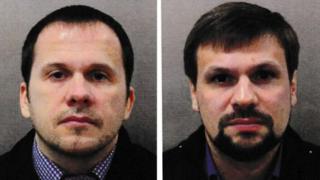
    Alexander Petrov and Ruslan Boshirov Image copyright Reuters Image caption Alexander Petrov and Ruslan Boshirov said they were tourists visiting Salisbury

    The two men named as suspects in the poisoning of a Russian ex-spy in the UK – Alexander Petrov and Ruslan Boshirov – have been speaking to RT, Russia’s state-run international broadcaster. They claim they were merely tourists visiting the English town of Salisbury at the time the poisoning happened. Here are key excerpts of their interview.

    “Well, we came there [to the UK] on 2 March, then went to a railway station to see the timetable. We arrived in Salisbury on 3 March and tried to walk through the town, but we lasted for only half an hour because it was covered in snow,” Mr Petrov said.

    “Of course, we went there to see Stonehenge, Old Sarum, but we couldn’t do it because there was muddy slush everywhere. The town was covered by this slush. We got wet, took the nearest train and came back [to London].”

    “We spent no more than an hour in Salisbury, mainly because of the lags between trains,” Mr Boshirov said. “Maybe we did [approach] Skripal’s house, but we don’t know where is it located.”

    When the interviewer asked them whether they had Novichok or any poison with them, they emphatically said no.

    What happened to the Skripals? The new Russian disinformation game Russian spy poisoning: What we know so far What is the GRU?

    Then she asked whether they had the Nina Ricci perfume bottle that had been shown as evidence.

    “Is it silly for decent lads to have women’s perfume? The customs are checking everything, they would have questions as to why men have women’s perfume in their luggage. We didn’t have it,” Mr Boshirov said.

    Both men sounded distressed as they spoke about how their lives had changed since they were named in the UK as Russian intelligence agents who attempted to poison the Skripals.

    “When your life [is] turned upside down, you don’t know what to do and where to go. We’re afraid of going out, we fear for ourselves, our lives and the lives of our loved ones,” Mr Boshirov said. 

    Asked whether they had recently been to any European state, the two said they had.

    “Sure… In Switzerland, we were a couple of times… We spent New Year in Switzerland.”

    The journey was part of their holiday, they said, though they had also been in Europe to do business related to sports nutrition.

    “We examine the market, look if there is something new – some biologically active additives, amino acids, vitamins, microelements. We pick up the most necessary, come here and decide how to deliver the new products from this market here.”

  • Skripal suspects: ‘We were just tourists’

    Alexander Petrov and Ruslan Boshirov Image copyright Reuters Image caption Alexander Petrov and Ruslan Boshirov said they were visiting Salisbury

    Two men named as suspects in the poisoning of a Russian ex-spy in the UK claim they were merely tourists.

    The men, named as Alexander Petrov and Ruslan Boshirov, told the RT channel that they went sightseeing in Salisbury but returned to London within an hour.

    They are accused by the UK of trying to kill Russian ex-spy Sergei Skripal and his daughter Yulia.

    The UK has described them as agents of Russia’s military intelligence service, the GRU.

    “The town was covered by this slush. We got wet, took the nearest train and came back” to London, they told RT.

    What happened to the Skripals? The new Russian disinformation game Russian spy poisoning: What we know so far What is the GRU?

    The UK’s Crown Prosecution Service have said there is enough evidence to charge the men, who are understood to have travelled to London from Moscow on 2 March on Russian passports.

    Two days later, police say, they sprayed the military-grade nerve agent Novichok on the front door of Mr Skripal’s home in the Wiltshire city of Salisbury, before travelling home to Russia later that day.

  • Pussy Riot activist Pyotr Verzilov ‘in hospital’

    Pyotr Verzilov was one of those jailed for invading the World Cup final pitch Image copyright Reuters Image caption Pyotr Verzilov was one of those jailed for invading the World Cup final pitch

    Pyotr Verzilov, an activist with Russian protest group Pussy Riot, is reported to have been taken to hospital in a serious condition.

    Relatives speaking to the Meduza website said they believed he may have suffered poisoning but there is no official word on his condition.

    He reportedly fell ill after a court hearing on Tuesday for fellow Pussy Riot activist Veronika Nikulshina.

    Mr Verzilov was one of the activists who invaded the World Cup final pitch.

    The story of Pussy Riot’s 2012 jailing

    Ms Nikulshina told Meduza that Mr Verzilov had complained of losing his sight, “then the ability to talk, then the ability to walk”.

    Image copyright Reuters Image caption Croatia’s Dejan Lovren squared up to Mr Verzilov during the World Cup pitch invasion in July
    Meduza said Mr Verzilov was in the toxicology department of a hospital in Moscow’s Sokolniki district.

    It said Mr Verzilov’s mother had not been allowed to see her son.

    Mr Verzilov, who also holds Canadian citizenship, was part of the Voina performance art group with Ms Tolokonnikova before it split in 2009 and then acted as spokesperson for Pussy Riot during the 2012 trial.

    He was jailed for 15 days this year along with three women activists after invading football’s World Cup final in Moscow on 15 July wearing police uniforms.

    How Pussy Riot managed to burst into final

    They said the action, under the name of Pussy Riot, was a protest against human rights abuses in Russia.

  • Russia’s Navalny challenged to a duel via Zolotov

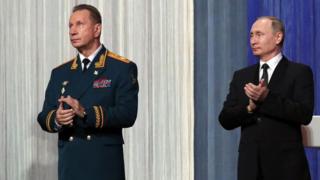
    Viktor Zolotov and Vladimir Putin Image copyright AFP Symbol caption Viktor Zolotov (left) used to paintings as Vladimir Putin’s bodyguard
    The Head of Russia’s Nationwide Guard has uploaded a video difficult competition leader and anti-corruption activist Alexei Navalny to a duel.

    Viktor Zolotov, who used to be Vladimir Putin’s bodyguard, promised Mr Navalny “payback” and said he could “make a juicy beefsteak out of” him.

    Mr Navalny printed a video closing month alleging that National Defend leaders were corrupt – angering Mr Zolotov.

    Mr Navalny is lately in jail for breaking anti-protest laws.

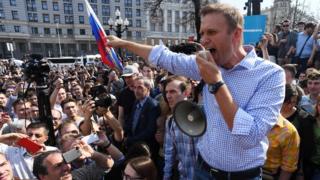
    he is Russia’s such a lot outstanding opposition chief and has led nationwide protests towards the government.

    Symbol copyright AFP Image caption Mr Navalny has led large anti-Putin rallies

    Mr Zolotov condemned Mr Navalny’s allegations in Tuesday’s video, calling them “offensive and nasty lies”.

    “No One has given you a top quality kick within the ass… I simply call you to a duel,” he said in a video revealed at the National Defend’s YouTube web page.

    “I promise to make a juicy beefsteak out of you in precisely a few minutes.”

    Media playback is unsupported for your instrument

    Media captionHow the Russian state uses surveillance and propaganda to discredit opponents

    Mr Navalny’s former marketing campaign chief Leonid Volkov mentioned Mr Zolotov had made some “very severe threats” – but also mocked his video, announcing he “will need to have forgotten” that the competition leader is in jail and can’t reply.

    Vladimir Putin’s spokesman Dmitry Peskov stated he supported Mr Zolotov’s opinion, as a result of “libel need to be nipped in the bud”, however added that he didn’t assume the video counted as a bodily threat.

    Human rights groups have accused Russia of cracking down on political warring parties and harassing political activists.

    (more…)