Tag: South Korea

  • Trump-Kim summit raises new questions over South Korean role

    When South Korea’s president shuttled between North Korea and the United States to broker their first-ever summit, he faced both praise and criticism over whether he was a peace-making mediator or was

    SINGAPORE (AP) – When South Korea’s president shuttled between North Korea and the United States to broker their first-ever summit, he faced both praise and criticism over whether he was a peace-making mediator or was helping North Korea find ways to weaken U.S.-led economic sanctions.

    A day after President Donald Trump and North Korean leader Kim Jong Un held their summit in Singapore, is it clearer whether Moon Jae-in played a positive or negative role? A quick answer: Probably not.

    Assessments of Moon’s diplomacy have become more divisive and complex, with Trump criticized in both South Korea and the U.S. for the concessions he made to North Korea, while others believe the summit will successfully prolong the current mood of detente.

    Meeting for about five hours, Trump and Kim exchanged an historic handshake, took a short stroll together, patted each other’s backs and signed a summit agreement. Trump promised to provide security guarantees to the North and suspend joint military drills with the South as long as negotiations with the North continue in “good faith.” Kim, in return, agreed to work toward a vague “complete denuclearization of the Korean Peninsula.”

    Those moves were unthinkable even several months ago, when the two unpredictable leaders threatened to nuke each other and traded a series of harsh personal insults.

    Moon issued a statement after the summit calling it a “huge step forward” toward peace that “helped break down the last remaining Cold War legacy on Earth.”

    He acknowledged that many difficulties are likely to lie ahead but vowed to work together with the U.S., North Korea and others to bring lasting peace to the Korean Peninsula.

    “We will never go back to the past again and never give up on this bold journey. History is a record of people who take action and rise to a challenge,” he said.

    But conservatives in South Korea slammed the summit, saying it failed to curb North Korea’s nuclear ambitions. They said both Trump and Moon should be blamed for not specifying steps and deadlines for North Korea’s nuclear disarmament, allowing it time to perfect its weapons program.

    “High expectations were met by low results,” said Nam Sung-wook, a North Korea expert at Seoul’s Korea University. “Moon, and then Trump, were quick to bite on North Korea’s invitation for talks. When Trump realized there wasn’t going to be anything substantial in return, it was impossible for him to back out because he had already gone too far.”

    U.S. officials had worked hard to get North Korea to agree to “complete, verifiable and irreversible” disarmament, and said they would not offer any major concessions until it took meaningful steps. Despite those efforts, Trump announced after the summit that he had agreed to suspend U.S. military drills with South Korea, something North Korea has long demanded.

    On Wednesday, North Korean state media said Trump had also agreed to the North’s desire for a step-by-step disarmament process with corresponding U.S. concessions at each step, rather than immediate disarmament as the U.S. had initially sought.

    Trump’s agreement to suspend the military drills apparently came without prior consultation with South Korea, baffling many who believe the U.S.-South Korea alliance, forged in blood during the 1950-53 Korean War, should remain strong throughout the push for a negotiated end to the nuclear tensions.

    “Why did South Korea and the U.S. form an alliance and stage military drills before the nuclear crisis flared? It’s because North Korea has been belligerent,” said Kim Taewoo, former president of the Korea Institute for National Unification in Seoul. He said cancellation of the drills “is really a bad idea … and (Trump) betrayed our people.”

    Asked to respond to Trump’s decision, Moon spokesman Kim Eui-kyeom said the allies must consider a “variety of ways to further facilitate dialogue” during the nuclear negotiations. He said South Korea is still trying to figure out the exact meaning and intent of Trump’s comments.

    Since taking office in May last year, Moon, a son of North Korean refugees, has sought to take the lead in diplomatic efforts to end the North Korean nuclear standoff, which had been dominated by world powers including the U.S. and China.

    Provocative nuclear and missile tests by North Korea last year initially gave Moon little diplomatic room to maneuver. But he kept trying to reach out to North Korea, and eventually found a role as a mediator after Kim offered in January to send a delegation to the South Korean Winter Olympics.

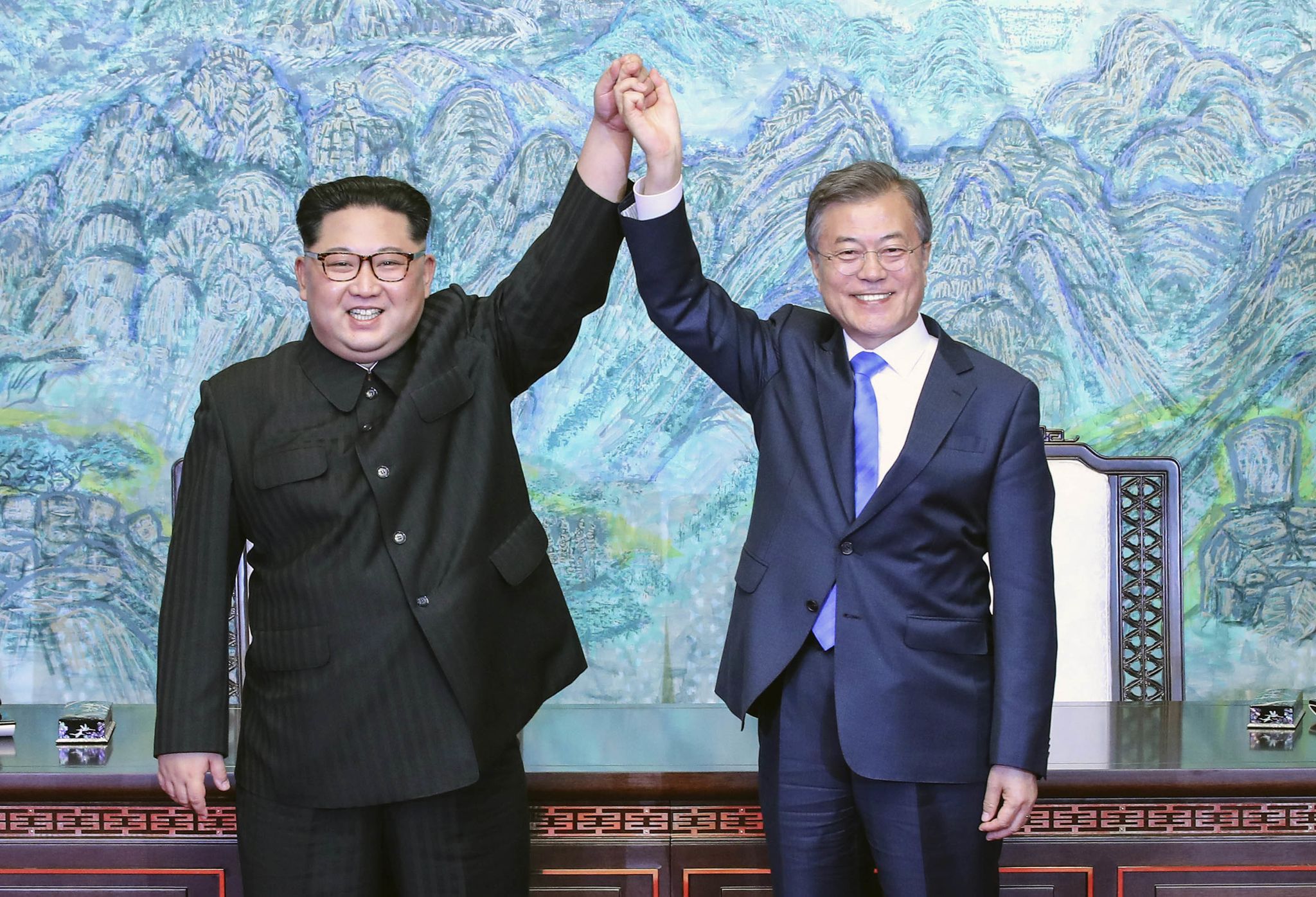
    After successful cooperation at the Olympics, Moon sent special envoys to North Korea who later traveled to Washington with Kim’s proposal for a summit with Trump. Moon held talks with Kim in April at which Kim agreed to work toward “complete denuclearization.” He met Kim again in May when Trump said he was withdrawing from the planned summit with Kim – a decision Trump quickly reversed.

    Experts now expect a temporary peace to continue since North Korea has probably won what it wanted from Tuesday’s summit and Trump is unlikely to back down from summit deals that he wants to portray as a diplomatic triumph.

    Analyst Hong Min at Seoul’s Korea Institute for National Unification said critics of the joint statement signed by Trump and Kim are missing a bigger point.

    He said it’s meaningful in itself that the leaders of the United States and North Korea met, talked and signed an agreement that will carry more weight and significance than any pact previously made between the wartime foes. The agreement’s aspirational language on denuclearization was a “strategic decision” to reduce pressure on both sides and keep the process going, Hong said.

    Trump and Kim agreed that their countries will quickly engage in follow-up talks led by U.S. Secretary of State Mike Pompeo and a “relevant high-level” North Korean official.

    Bong Youngshik, a professor at Seoul’s Yonsei University, said it’s too early to predict how Trump’s cancellation of the military drills will play out in future nuclear negotiations. He said North Korea is likely to consider Trump’s decision a temporary measure while it remains in negotiations with Washington.

    Moon may not face any immediate serious political repercussions at home since North Korea will likely take gradual steps toward disarmament to prevent others from thinking it reneged on its pledge. But if Trump seeks re-election in 2020, his government is likely to apply more pressure on North Korea to make substantial progress in denuclearization, which could bring the nuclear issue to another critical point, said Shin Beomchul of Seoul’s Asan Institute for Policy Studies.

    ___

    Kim Tong-hyung reported from Seoul, South Korea.
  • The Latest: Trump’s claim of no nuke threat seen as dubious

    The Latest on the summit between President Donald Trump and North Korean leader Kim Jong Un (all times local):

    WASHINGTON (AP) – The Latest on the summit between President Donald Trump and North Korean leader Kim Jong Un (all times local):

    11:30 a.m.

    Secretary of State Mike Pompeo says he’s confident that U.S. talks with North Korea will resume “sometime in the next week.”

    Pompeo says he doesn’t know the exact timing. Speaking in Seoul, he says he expects it to happen fairly quickly after he and the North Koreans return to their nations. Pompeo returns late Thursday to the U.S.

    He says President Donald Trump is “in the lead” but that “I will be the person who takes the role of driving this process forward.”

    He says much more work has been done by the U.S. and North Korean that couldn’t be encapsulated in the Trump-Kim Jong Un statement. So he says teams will now work to make more progress on those items.

    ___

    11:20 a.m.

    Secretary of State Mike Pompeo says the United States wants North Korea to take major nuclear disarmament steps within the next two years.

    Pompeo is laying out an ambitious timeline for denuclearization following President Donald Trump’s meeting with Kim Jong Un. He says he won’t disclose specific timelines but that the administration is hopeful that “major, major disarmament” steps can occur before the end of Trump’s first term. The term ends in January 2021.

    Pompeo is also urging skepticism after North Korean official media said Trump had agreed to a step-by-step approach to denuclearization. Pompeo isn’t being specific but says that “one should heavily discount some things that are written in other places.”

    Pompeo spoke to reporters from Seoul, South Korea.

    ___

    11:15 a.m.

    Secretary of State Mike Pompeo says that North Korean leader Kim Jong Un understands that “there will be in-depth verification” of nuclear commitments in any deal with the U.S.

    Pompeo is pushing back on criticism that the joint agreement signed by Kim and President Donald Trump includes no mention of verifying North Korean nuclear disarmament. Ahead of Trump’s summit with Kim, the U.S. had said disarmament must be “complete, verifiable and irreversible.”

    But Pompeo tells reporters that it’s silly to focus on the lack of the word “verifiable.” He says that’s because the agreement does refer to “complete” denuclearization of the Korean Peninsula. Pompeo says that “in the minds of everyone concerned,” the word “complete” encompasses “verifiable.”

    Pompeo says: “I am equally confident they understand that there will be in-depth verification.”

    ___

    11:10 a.m.

    Secretary of State Mike Pompeo says joint U.S.-South Korea military exercises will resume if North Korea stops negotiating in good faith over its nuclear program.

    Pompeo is in South Korea a day after President Donald Trump met with Kim Jong Un and announced the U.S. would freeze what he called “war games” with North Korea.

    Pompeo says he was there when Trump talked about it with Kim. He says Trump “made very clear” that the condition for the freeze was that good-faith talks continue. He says if the U.S. concludes they no longer are in good faith, the freeze “will no longer be in effect.”

    Pompeo says Trump was “unambiguous” in conveying that to Kim.

    ___

    11 a.m.

    House Speaker Paul Ryan says President Donald Trump should be “applauded” for his meeting with North Korea leader Kim Jong Un. But Ryan is cautioning on Wednesday that the next steps toward an agreement won’t go fast.

    The Wisconsin Republican, who is retiring this year, told reporters that “The president needed to disrupt the status quo, and the president has disrupted the status quo” with the historic meeting in Singapore. He said “the president should be applauded….Now let’s go get an agreement.”

    Trump and Kim signed a joint statement that contained a repeat of past promises to work toward a denuclearized Korean Peninsula, but the details haven’t been nailed down.

    He cautioned that no one should expect that process to go quickly. “Time,” he said, “will tell how this ends.”

    ___

    10 a.m.

    President Donald Trump is challenging skeptical media coverage of his historic summit with North Korea’s Kim Jong Un. He says “Fake News” is the nation’s “biggest enemy.”

    Trump writes on Twitter that “the Fake News, especially NBC and CNN” are “fighting hard to downplay the deal with North Korea.”

    Trump says that “500 days ago they would have ‘begged’ for this deal-looked like war would break out.”

    The president says the country’s “biggest enemy is the Fake News so easily promulgated by fools!”

    Trump has been tweeting about his talks with Kim since Air Force One returned to the United States early Wednesday morning, arguing that the talks with North Korea have made the U.S. safer. Trump’s claim is dubious considering Pyongyang’s significant weapons arsenal.

    ___

    7:25 a.m.

    President Donald Trump is defending his calls to end military exercises with South Korea that allies have said is important to security in the Asia Pacific region.

    Trump says on Twitter after returning from his Singapore summit that “we save a fortune by not doing war games, as long as we are negotiating in good faith.”

    Trump has said the U.S. and South Korea should stop their joint military exercises as long as both sides are negotiating in good faith, which the president says is happening.

    Back in the United States, Trump is tweeting about his historic summit with North Korean leader Kim Jong Un. He says there is no longer a nuclear threat from North Korea even though experts estimate that Kim’s government has enough fissile material for 20 to 60 bombs.

    __

    6:15 a.m.

    President Donald Trump says on Twitter, “There is no longer a Nuclear Threat from North Korea,” as he returns to the United States after his historic summit with North Korea leader Kim Jong Un.

    Trump says on Twitter that “everybody can now feel much safer than the day I took office.”

    He says before he took office, “people were assuming that we were going to War with North Korea,” and President Barack Obama said North Korea was the nation’s biggest problem.

    Trump and Kim signed an agreement to work toward denuclearization, but it appears weaker than past deals that failed. Independent experts estimate North Korea now has enough fissile material for 20 to 60 bombs, and it has tested missiles that could potentially deliver a nuclear weapon to the U.S. mainland.

    ___

    5:37 a.m.

    President Donald Trump has arrived back in Washington from his historic nuclear summit with North Korea’s Kim Jong Un in Singapore.

    Air Force One touched down at Joint Base Andrews early Wednesday morning, completing the president’s marathon trip to Asia for talks with the North Korean leader. The president made refueling stops in Guam and Hawaii on his return to Washington.

    While his aircraft refueled in Hawaii, Trump thanked Kim for “taking the first bold step toward a bright new future for his people,” saying their summit on Tuesday “proves that real change is possible!”

    During his return, Trump spoke with South Korean Prime Minister Moon Jae-in and Japanese Prime Minister Shinzo Abe.

    ___

    6:25 p.m.

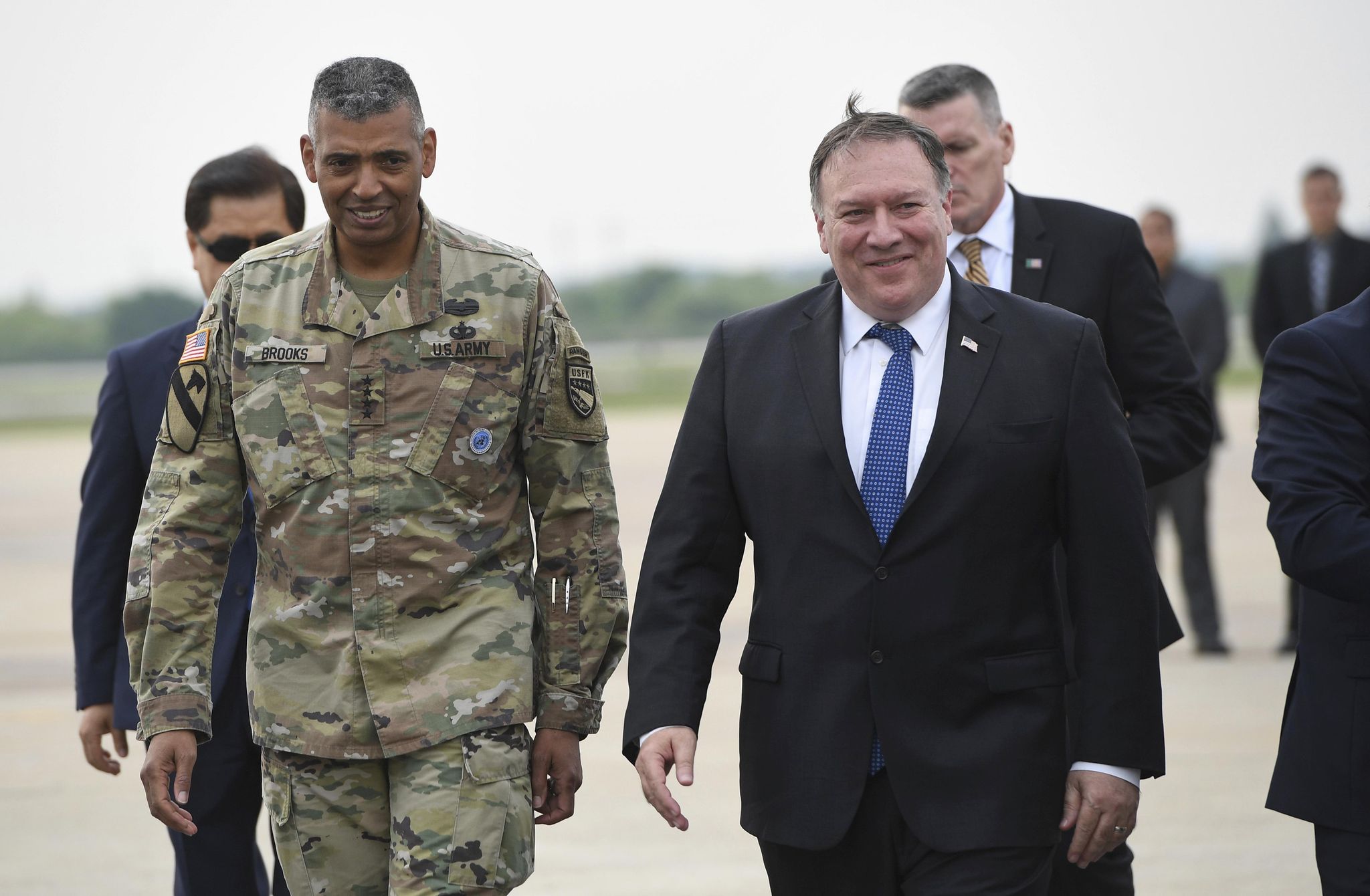
    U.S. Secretary of State Mike Pompeo has landed at Osan Air Base south of Seoul ahead of meetings with America’s allies in the aftermath of the summit between President Donald Trump and North Korean leader Kim Jong Un.

    He’s expected to meet privately in the evening with Gen. Vincent Brooks, commander of U.S. Forces Korea.

    Pompeo will meet President Moon Jae-in on Thursday morning to discuss the summit.

    Japanese Foreign Minister Taro Kono is also heading to Seoul and is due to meet with Pompeo and his South Korean counterpart. Pompeo, the former CIA director, then plans to fly to Beijing to update the Chinese government on the talks.

    ___

    5:05 p.m.

    Russia is welcoming the outcome of the summit between President Donald Trump and North Korean leader Kim Jong Un.

    Kremlin spokesman Dmitry Peskov says “one can only welcome the fact that such a meeting took place and that direct dialogue was begun.”

    Peskov tells reporters in Moscow on Wednesday that the meeting helps de-escalate tensions and push the situation away “from the critical point where it was just a few months ago.”

    Peskov says the meeting confirms Russian President Vladimir Putin’s view that “there is no alternative to political and diplomatic means in solving the problem of the Korean Peninsula.”

    Peskov adds, however, that given how complicated the situation is around North Korea, the Kremlin isn’t expecting a quick resolution.

    ___

    3:20 p.m.

    A spokesman of South Korean President Moon Jae-in says Washington and Seoul need to consider a “variety of ways to further facilitate dialogue” while they are engaged in nuclear negotiations with Pyongyang.

    Kim Eui-kyeom made the comments on Wednesday when asked to respond to President Donald Trump, who following his summit with North Korean leader Kim Jong Un said that the United States and South Korea should stop their joint military exercises “as long as we are negotiating in good faith.”

    Kim, Moon’s spokesman, says Seoul is still trying to figure out the exact meaning and intent of Trump’s comments.

    ___

    10:50 a.m.

    The U.S. top diplomat is jetting to South Korea to brief the country’s president as Asian allies try to parse the implications of the extraordinary nuclear summit in Singapore between President Donald Trump and North Korea’s Kim Jong Un.

    South Korea’s presidential office says U.S. Secretary of State Mike Pompeo will meet President Moon Jae-in Thursday morning to discuss the meeting, which made history as the first between sitting leaders of the U.S. and North Korea.

    Trump and Kim reached a broad agreement that offered few specifics but included promises of U.S. security guarantees and a reiteration from Kim of his country’s commitment to “complete denuclearization of the Korean Peninsula.”

    Trump however seems to have caught allies off guard by saying he would stop U.S.-South Korean war games.

  • Donald Trump to host South Korea’s Moon Jae-in ahead of summit with North Korea’s Kim Jong-un

    South Korean President Moon Jae-in will visit President Trump at the White House later this month ahead of Mr. Trump’s historic summit with North Korea’s leader on the pivotal issue of denuclearizatio

    South Korean President Moon Jae-in will visit President Trump at the White House later this month ahead of Mr. Trump’s historic summit with North Korea’s leader on the pivotal issue of denuclearization.

    The White House said Friday that Mr. Trump will host Mr. Moon on May 22, their third meeting since Mr. Trump took office.

    White House press secretary Sarah Huckabee Sanders said Mr. Trump’s upcoming meeting with North Korean leader Kim Jong-un will be high on the agenda, following Mr. Moon’s first meeting with Mr. Kim on April 27.

    “President Trump and President Moon will continue their close coordination on developments regarding the Korean Peninsula,” she said. “This third summit between the two leaders affirms the enduring strength of the United States–Republic of Korea alliance and the deep friendship between our two countries.”

    Mr. Trump said Friday that the U.S. and North Korea have agreed on the date and location of their summit, but he didn’t disclose the details. Among the locations under consideration are Singapore, Mongolia and the demilitarized zone between North and South Korea.

  • North Korea agrees to a moratorium on nuclear and missile tests, will hold landmark summit in April

    North Korean leader Kim Jong-un has agreed to stop nuclear and missile tests if his country holds talks with the United States on denuclearizing the Korean peninsula.

    North Korean leader Kim Jong-un has agreed to stop nuclear and missile tests if his country holds talks with the United States on denuclearizing the Korean peninsula.

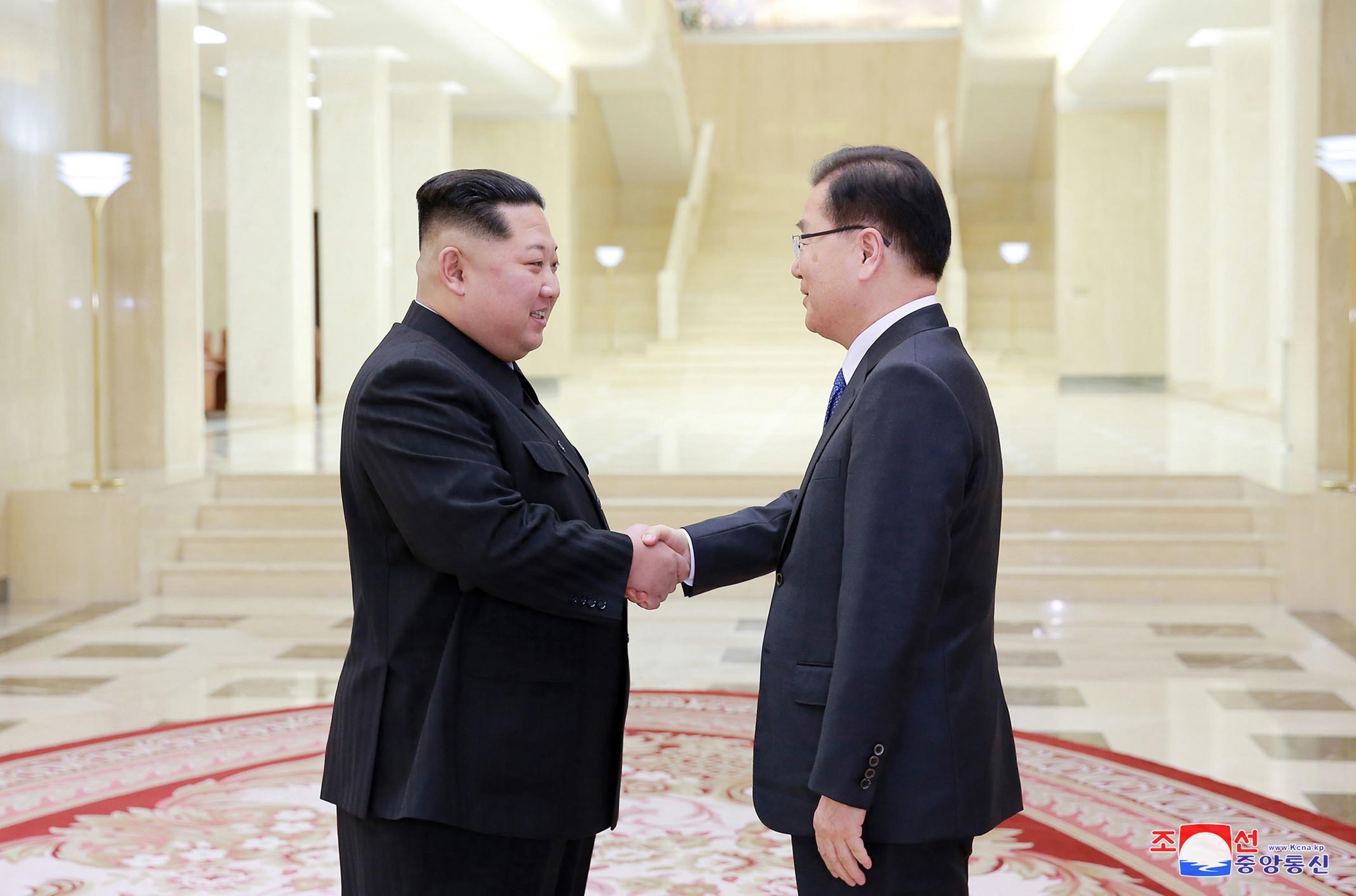
    The breakthrough was announced Tuesday by Chung Eui-yong, South Korea’s presidential national security director, after a rare visit to Pyongyang.

    “The North expressed its willingness to hold a heartfelt dialogue with the United States on the issues of denuclearization and normalizing relations with the United States,” he said in a statement. “It made it clear that while dialogue is continuing, it will not attempt any strategic provocations, such as nuclear and ballistic missile tests.”

    PHOTOS: South Korea meeting thrusts North’s Kim into the limelight

    The promising move followed a flurry of cooperative steps taken by the Koreas during last month’s Winter Olympic games in Pyeongchang, South Korea.

    President Trump welcomed the turn of events with a note of caution.

    “We will see what happens!” he tweeted.

    In a later tweet, he described it as “possible progress being made in talks with North Korea.”

    “For the first time in many years, a serious effort is being made by all parties concerned. The World is watching and waiting! May be false hope, but the U.S. is ready to go hard in either direction!” wrote the president.

    The shift from the North also follows increasing pressure from the United States. The Trump administration has ratcheted up economic sanctions, while Mr. Trump took a hard line and demanded a nuclear-free Korean peninsula in exchange for talks.

    The standoff was repeatedly punctuated by Mr. Trump and Mr. Kim trading insults, including the U.S. president taunting his foe as “Little Rocket Man.”

    The North had steadfastly refused to even consider surrendering its nuclear arsenal or missile program, now capable of hitting the U.S. mainland and heralded by Mr. Kim as an essential deterrent against American invasion plans.

    Vice President Mike Pence, who led the U.S. delegation to the Olympic opening ceremony and avoided interaction there with North Korea officials, vowed to keep pressure on Mr. Kim’s rogue regime.

    “Whichever direction talks with North Korea go, we will be firm in our resolve,” he said. “All options are on the table and our posture toward the regime will not change until we see credible, verifiable and concrete steps toward denuclearization.”

    Mr. Chung led a 10-member South Korean delegation that met with Mr. Kim during a two-day visit to Pyongyang, North Korea’s capital. They returned on Tuesday.

    The two Koreas also agreed to hold their third-ever summit at a tense border village in late April.

    Mr. Chung said the leaders will establish a “hotline” communication channel to lower military tensions and would speak together before the planned summit.

    The two past summits, in 2000 and 2007, were held between Mr. Kim’s late father, Kim Jong-il, and two liberal South Korean presidents. They resulted in a series of cooperative projects between the Koreas that were scuttled during subsequent conservative administrations in South Korea.

    Mr. Chung said North Korea agreed to suspend nuclear and missile tests for as long as it holds talks with the United States.

    North Korea also made it clear that it would not need to keep its nuclear weapons if military threats against it are removed and it receives a credible security guarantee, Mr. Chung said.

    • This story is based in part on wire service reports.