Tag: Kim Tong Hyung

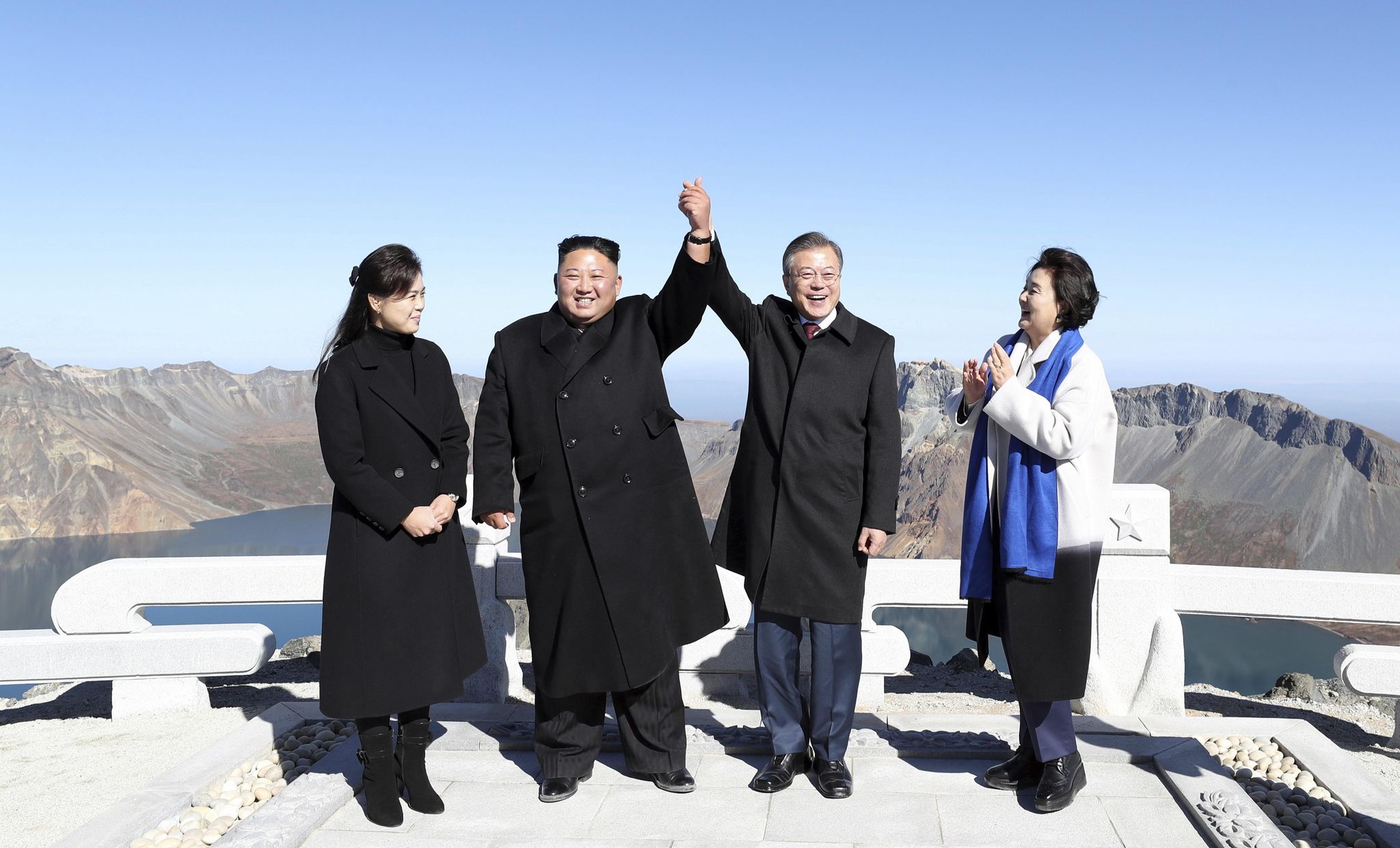
  • Kim Jong-un, Moon Jae-in join hands on peak of sacred North Korean volcano

    The leaders of the rival Koreas took to the road for the final day of their summit Thursday, standing on the peak of a beautiful volcano considered sacred in the North and a centerpiece of propaganda

    PYONGYANG, North Korea (AP) — The leaders of the rival Koreas took to the road for the final day of their summit Thursday, standing on the peak of a beautiful volcano considered sacred in the North and a centerpiece of propaganda used to legitimize the Kim family’s rule, their hands clasped and raised in a pose of triumph. Their trip to the mountain on the North Korean-Chinese border, and the striking photo-op that will resonate in both Koreas, followed a day of wide-ranging agreements they trumpeted as a major step toward peace.

    However, their premier accord on the issue that most worries the world — the North’s pursuit of nuclear-tipped missiles that can accurately strike the U.S. mainland — contained a big condition: Kim Jong-un stated that he would permanently dismantle North Korea’s main nuclear facility only if the United States takes unspecified corresponding measures.

    Kim and South Korean President Moon Jae-in flew separately to an airport near Mount Paektu on Thursday morning where they then met up and drove to the mountain.

    Photos showed the leaders smiling broadly as they posed at the summit, their wives grinning at their sides, a brilliant blue sky and the deep crater lake that tops the volcano in the background; they also toured the shores of the lake. Members of the Kim family are referred to as sharing the “Paektu Bloodline,” and the volcano is emblazoned on the national emblem and lends its name to everything from rockets to power stations.

    Many South Koreans also feel drawn to the volcano, which, according to Korean mythology was the birthplace of Dangun, the founder of the first ancient Korean kingdom, and has long been considered one of the most beautiful places on the peninsula. Not everyone was pleased, though. About 100 anti-North Korea protesters rallied in central Seoul to express anger about the summit and displayed slogans that read, “No to SK-NK summit that benefits Kim Jong Un.”

    Moon arrived in South Korea later Thursday and was expected to brief the media.

    The leaders are basking in the glow of the joint statement they settled Wednesday. Compared to the vague language of their two earlier summits, Kim and Moon seem to have agreed on an ambitious program meant to tackle soaring tensions last year that had many fearing war as the North tested a string of increasingly powerful weapons.

    Kim promised to accept international inspectors to monitor the closing of a key missile test site and launch pad and to visit Seoul soon, and both leaders vowed to work together to try to host the Summer Olympics in 2032.

    But while containing several tantalizing offers, their joint statement appeared to fall short of the major steps many in Washington have been looking for – such as a commitment by Kim to provide a list of North Korea’s nuclear facilities, a solid step-by-step timeline for closing them down, or an agreement to allow international inspectors to assess progress or discover violations.

    It also was unclear what “corresponding steps” North Korea wants from the U.S. to dismantle its nuclear site.

    The question is whether it will be enough for President Donald Trump to pick up where Moon has left off. Trump told reporters Wednesday that the outcome of the summit was “very good news” and that “we’re making tremendous progress” with North Korea. He didn’t indicate in his brief remarks whether the U.S. would be willing to take further steps to encourage North Korean action on denuclearization.

    Declaring they had made a major step toward peace, Moon and Kim stood side by side Wednesday as they announced their agreement.

    “We have agreed to make the Korean Peninsula a land of peace that is free from nuclear weapons and nuclear threat,” Kim said. “The road to our future will not always be smooth and we may face challenges and trials we can’t anticipate. But we aren’t afraid of headwinds because our strength will grow as we overcome each trial based on the strength of our nation.”

    Moon urged unity for all Koreans in a speech he gave Wednesday night to the crowd gathered for North Korea’s signature mass games. “We have lived together for 5,000 years and lived in separation for 70 years. I now propose that we completely eliminate the hostility of the past 70 years and take a big step forward in peace so that we can become one again.”

    Historians say the 5,000-year timeline of Korean history is a groundless claim that became part of South Korea’s official narrative after being inserted in school textbooks during the rule of former dictator Chun Doo-hwan.

    This week’s summit comes as Moon is under increasing pressure from Washington to find a path forward in efforts to get Kim to completely – and unilaterally – abandon his nuclear arsenal.

    Trump has maintained that he and Kim have a solid relationship, and both leaders have expressed interest in a follow-up summit to their meeting in June in Singapore. North Korea has been demanding a declaration formally ending the Korean War, which was stopped in 1953 by a cease-fire, but neither leader mentioned it Wednesday as they read the joint statement.

    In the meantime, however, Moon and Kim made concrete moves of their own to reduce tensions on their border.

    According to a statement signed by the countries’ defense chiefs, the two Koreas agreed to establish buffer zones along their land and sea borders to reduce military tensions and prevent accidental clashes. They also agreed to withdraw 11 guard posts from the Demilitarized Zone by December and to establish a no-fly zone above the military demarcation line that bisects the two Koreas that will apply to planes, helicopters and drones.

    Other agreements aimed at removing some longstanding irritants from their relations, such as allowing more contact between families divided by the Korean War. Moon also appeared to be making good on his proposals to help build up the North’s infrastructure and open cross-border rail links.

    ___

    Klug reported from Seoul. Associated Press writers Hyung-jin Kim and Kim Tong-hyung in Seoul contributed to this report.
  • South Korea meeting thrusts North’s Kim into the limelight

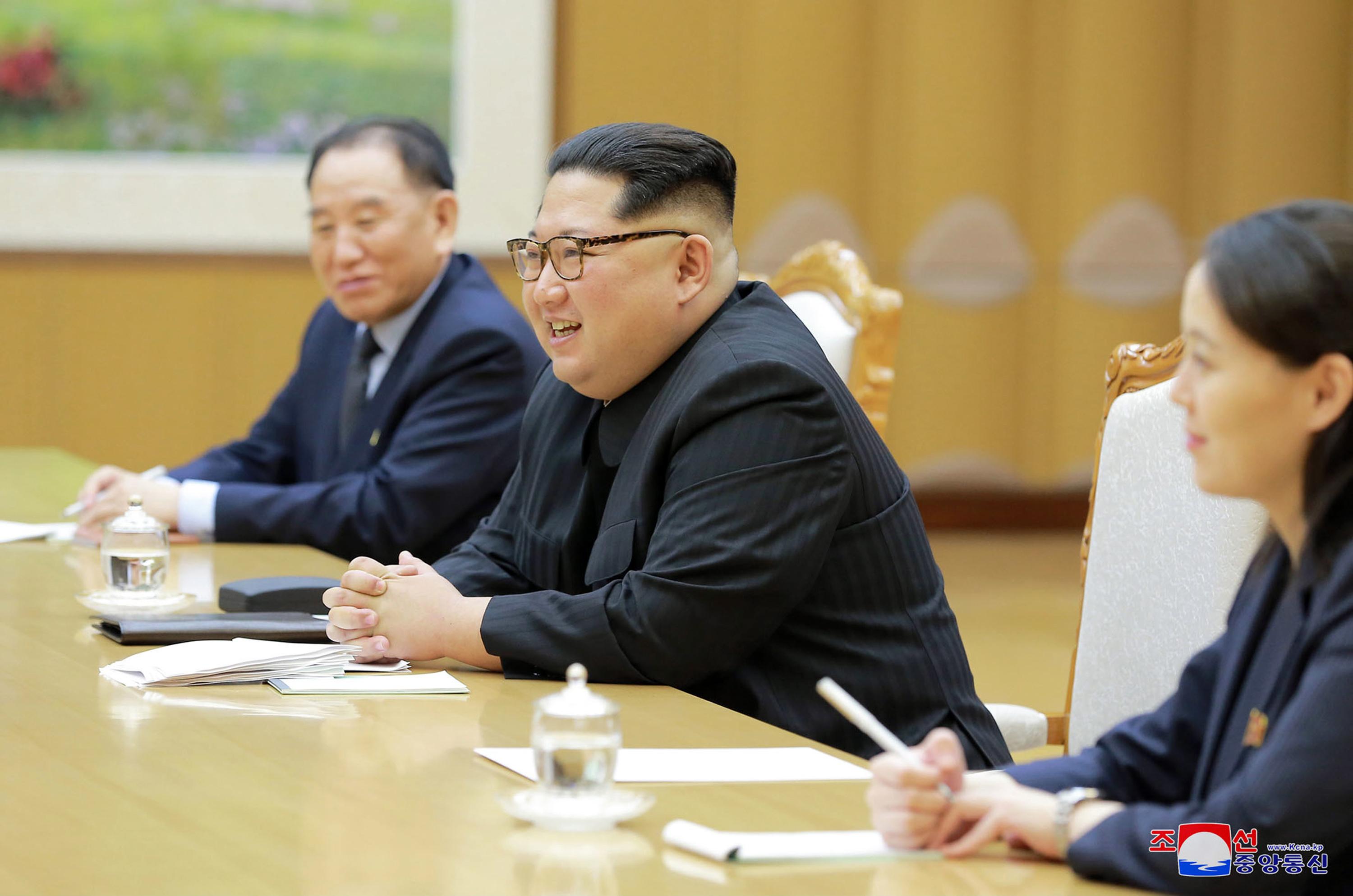
    North Korean leader Kim Jong Un grins, just on the verge of a belly laugh, as he grasps the hand of a visiting South Korean official. He sits at a wide conference table and beams as the envoys look on

    SEOUL, South Korea (AP) – North Korean leader Kim Jong Un grins, just on the verge of a belly laugh, as he grasps the hand of a visiting South Korean official. He sits at a wide conference table and beams as the envoys look on deferentially. He smiles broadly again at dinner, his wife at his side, the South Koreans seeming to hang on his every word.

    Kim is used to being the center of gravity in a country that his family has ruled with unquestioned power since 1948, but the chance to play the senior statesman on the Korean Peninsula with a roomful of visiting South Koreans has afforded the autocratic leader a whole new raft of propaganda and political opportunities.

    Photos released by North Korean state media Tuesday showing Kim meeting with the envoys are all the more remarkable coming just months after a barrage of North Korean weapons tests and threats against Seoul and Washington had many fearing war.

    It wasn’t immediately clear how the images were reported in the North, but they spread rapidly across the southern part of the peninsula a day after Pyongyang said Kim had an “openhearted talk” in Pyongyang with 10 envoys for South Korean President Moon Jae-in. Kim reportedly expressed his desire to “write a new history of national reunification” during a dinner that Seoul said lasted about four hours.

    The meeting Monday marked the first time South Korean officials have met with the young North Korean leader in person since he took power after his dictator father’s death in late 2011. It’s the latest sign that the Koreas are trying to mend ties after one of the tensest years in a region that seems to be permanently on edge.

    Given the robust history of bloodshed, threats and animosity on the Korean Peninsula, there is considerable skepticism over whether the Koreas’ apparent warming relations will lead to lasting peace. North Korea, some believe, is trying to use improved ties with the South to weaken U.S.-led international sanctions and pressure, and to provide domestic propaganda fodder for Kim.

    But each new development also raises the possibility that the rivals can use the momentum from the good feelings created during North Korea’s participation in the South’s Pyeongchang Winter Olympics last month to ease a standoff over North Korea’s nuclear ambitions and restart talks between Pyongyang and Washington.

    The role of a confident leader welcoming visiting, and lower-ranking, officials from the rival South is one Kim clearly relishes. Smiling for cameras, he posed with the South Koreans and presided over what was described by the North’s official Korean Central News Agency as a “co-patriotic and sincere atmosphere.”

    Many in Seoul and Washington will want to know if, the rhetoric and smiling images notwithstanding, there’s any possibility Kim will negotiate over the North’s breakneck pursuit of an arsenal of nuclear missiles that can viably target the U.S. mainland.

    The North has repeatedly and bluntly declared it will not give up its nuclear bombs. It also hates the annual U.S.-South Korean military exercises that were postponed because of the Olympics but will likely happen later this spring. And achieving its nuclear aims rests on the North resuming tests of missiles and bombs that set the region on edge.

    But there was nothing about the Koreas’ very real differences in the North Korean report. Kim was said to have offered his views on “activating the versatile dialogue, contact, cooperation and exchange” between the countries

    He was also said to have given “important instruction to the relevant field to rapidly take practical steps for” a summit with South Korean President Moon, which the North proposed last month.

    Moon, a liberal who is keen to engage the North, likely wants to visit Pyongyang. But he must first broker better ties between North Korea and Washington, Seoul’s top ally and its military protector.

    In the meantime, Moon sent his national security director, Chung Eui-yong, to head the 10-member South Korean delegation that was sent to Pyongyang. Chung’s trip is the first known high-level visit by South Korean officials to the North in about a decade.

    The South Korean delegates have another meeting with North Korean officials on Tuesday before returning home, but it’s unclear if Kim will be there.

    Kim was said to have expressed at the dinner his “firm will to vigorously advance the north-south relations and write a new history of national reunification by the concerted efforts of our nation to be proud of in the world.”

    There is speculation that better inter-Korean ties could pave the way for Washington and Pyongyang to talk about the North’s nuclear weapons. The United States, however, has made clear that it doesn’t want empty talks and that all options, including military measures, are on the table.

    Previous warming ties between the Koreas have come to nothing amid North Korea’s repeated weapons tests and the North’s claims that the annual U.S.-South Korean war games are a rehearsal for an invasion.

    Before leaving for Pyongyang, Chung said he would relay Moon’s hopes for North Korean nuclear disarmament and a permanent peace on the peninsula.

    Chung’s delegation includes intelligence chief Suh Hoon and Vice Unification Minister Chun Hae-sung. The South Korean presidential Blue House said the high-profile delegation is meant to reciprocate the Olympic trip by Kim Jong Un’s sister, Kim Yo Jong, who became the first member of the North’s ruling family to come to South Korea since the end of the 1950-53 Korean War.

    Kim Yo Jong, who also attended Monday’s dinner, and other senior North Korean officials met with Moon during the Olympics, conveyed Kim Jong Un’s invitation to visit Pyongyang and expressed their willingness to hold talks with the United States.

    After the Pyongyang trip, Chung’s delegation is scheduled to fly to the United States to brief officials about the outcome of the talks with North Korean officials.

    President Donald Trump has said talks with North Korea will happen only “under the right conditions.”

    If Moon accepts Kim’s invitation to visit Pyongyang, it would be the third inter-Korean summit talks. The past two summits, one in 2000 and the other in 2007, were held between Kim’s late father, Kim Jong Il, and two liberal South Korean presidents. They resulted in a series of cooperative projects between the Koreas that were scuttled during subsequent conservative administrations in the South.

    ___

    Associated Press writers Hyung-jin Kim and Kim Tong-hyung contributed to this report.