Video Putin and crown prince top five
Tag: Mauricio Macri
-
Mauricio Macri downplays Argentina’s economy problems
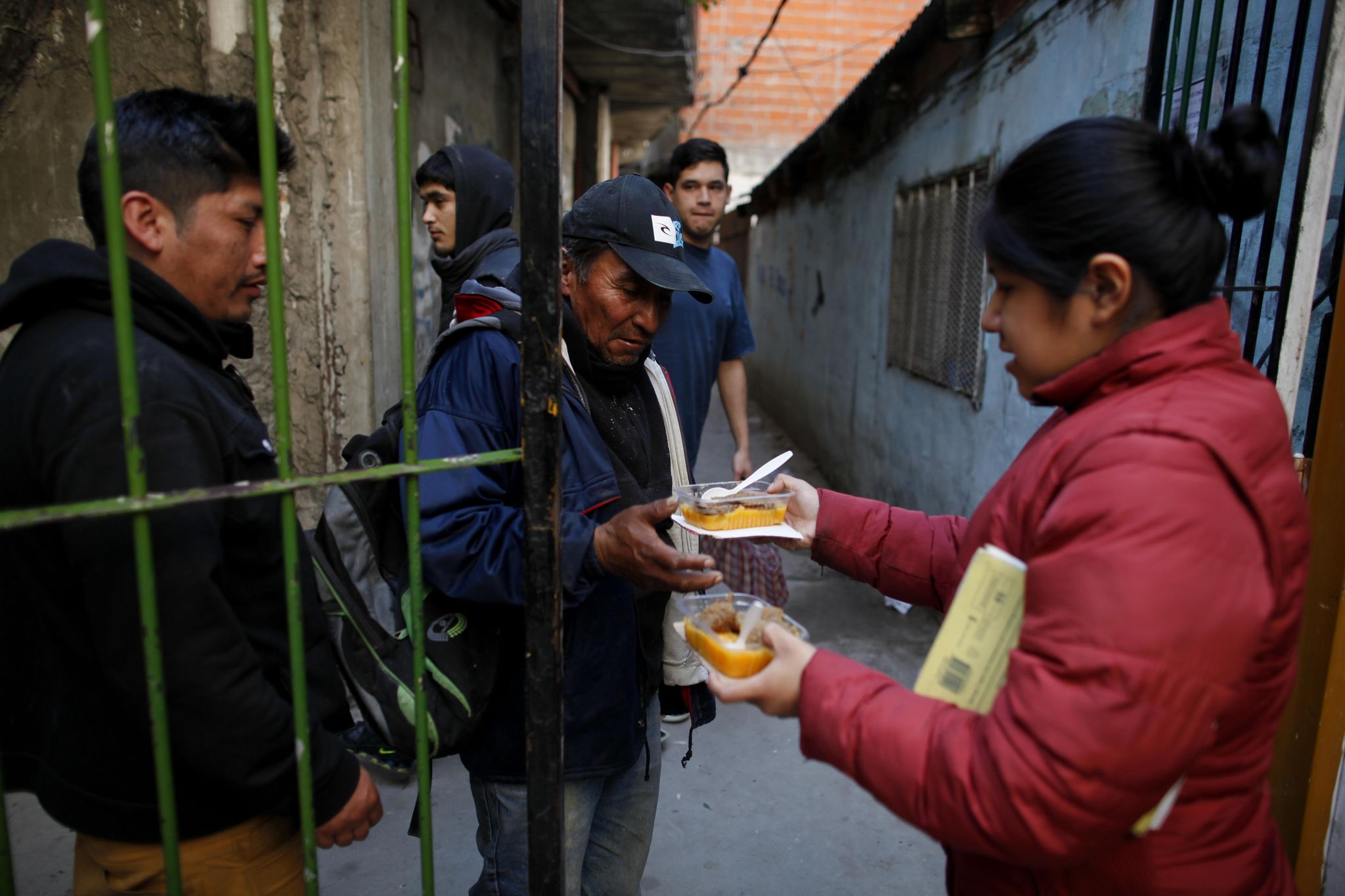
Having emerged from one of the world’s worst currency implosions of the new century, Argentine consumers are suddenly confronting a reprise.
BUENOS AIRES — For ordinary Argentines, it has been a shocking return to the bad old days, a deja vu of shortages, job losses and bailouts that many thought the country had finally ended.
Facing a national election a year away, the ever-upbeat President Mauricio Macri never tires of reassuring Argentines that they are on “the right path” out of a “storm.”
But to local economists, even those friendly to the conservative Mr. Macri’s pro-business bent, his imagery doesn’t quite capture the state of an economy predicted to shrink by 2.4 percent this year and had to be propped up just last week by an expanded $57 billion line of credit from the International Monetary Fund. Having emerged from one of the world’s worst currency implosions of the new century, consumers are suddenly confronting a reprise.
Things aren’t nearly as dire as the post-2001 years, and a more apt metaphor, former National Bank board member Facundo Martinez Maino said, might be that of a car-wreck victim hospitalized after a head-on collision.
“Right now, staying alive is all that matters,” said Mr. Martinez Maino, now the chief economist at a prominent local consulting firm. “You’re in a totally sterile room, under controlled temperature, and you can’t venture out or eat [without] a feeding tube.”
It’s a grim picture reflected by key indicators — Argentina’s inflation rate is now topped around the world only by those of Venezuela, Sudan and South Sudan — and painful even for the urban middle class, a key component of Mr. Macri’s political base.
“The situation is critical, unfortunately,” Graciela Clouet, a 66-year-old lawyer, said last week as she shopped for groceries in an upscale Buenos Aires neighborhood. “You don’t know where we’re headed, and you worry.”
Prices are constantly being hiked, Ms. Clouet said, while the decline of the peso, which has already lost more than half its value this year, is having ripple effects on the rising cost of gasoline and consumer goods across the board.
But what bothers her the most, she said, is the sense of uncertainty, which Mr. Macri’s repeatedly unkept promises that “the worst is over” have done little to ease.
“I want there to be a direction … for us to go toward someplace,” Ms. Clouet said. “I feel like we’re improvising.”
For market movers and shakers, the chaotic state of the economy has long contrasted with the president’s near-dogmatic confidence and, worse, conjured up memories of those crises past — including Argentina’s cataclysmic 2001 default and social meltdown.
“We have gotten to a situation that, as a snapshot, is one of the worst since 2001 in terms of devaluation, inflation, recession and economic perspectives,” Mr. Martinez Maino said. “We’re in one of the worst situations since that collapse.”
He added, though, that the two scenarios are vastly different in causes and scope.
Fears of a rerun
Even the sense that the country may be headed down a similar road is precisely what Mr. Macri — and anybody else interested in stabilizing the economy — is desperately hoping to avoid, said Mariano de Vedia, a political analyst for the La Nacion daily.
“There’s an old saying here in Argentina: ‘He who burns himself with milk sees a cow and cries …,’” Mr. de Vedia said. “Already, salaries are worth less and less, layoffs are beginning to happen and the dollar heads to the skies.”
For Argentina’s lower and middle classes, meanwhile, keeping up with ever-increasing food, utility and transportation costs is becoming increasingly difficult, economic analyst Jose Luis Espert said.
“This year, with an inflation between 40 and 50 percent and salaries that rise between 25 and 30 percent, the real-wage drop is 15 percent,” Mr. Espert said. “Companies are closing, stores are closing, and there is a very, very violent drop in consumption.”
For Roberto Rodriguez, who co-owns a florist shop on a lively Buenos Aires street corner, that means business has been “totally paralyzed.”
“You notice it in the stores around,” he said. “[This is] a spot with pretty good purchasing power, and even so, we’re feeling it.”
Mr. Rodriguez said he still plans to back Mr. Macri if he runs for re-election next year, hinting that he favors the president’s “change” agenda over the often inflexible protectionism of his predecessor, leftist Cristina Fernandez.
Although Ms. Fernandez may have handed over a bloated government whose coffers had been emptied by populist spending and corruption, most commentators agree that, three years into his term, Mr. Macri shares a large chunk of the blame for the country’s predicament.
By hastily eliminating currency controls, insisting on unrealistic inflation goals and taking on debt in an undisciplined and unsavvy manner, Mr. Macri committed key errors from the get-go, Mr. Martinez Maino said.
“Today, we’re faced more with macroeconomic problems generated by this administration than with inherited problems, which we’re also faced with,” he said. “All three elements failed: diagnosis, policies and management.”
To Mr. Espert, the president’s latest attempt to turn things around with a dual commitment to a no-deficit budget and steady money supply thanks to the expanded IMF credit line likely comes a day late and a peso short.
“If ‘zero deficit’ and ‘zero issuance’ had been announced [in 2015], rejecting [Ms. Fernandez’s] inheritance, it would have been one thing,” he said. “Today, almost three years later … and a year before the elections, it lacks credibility.”
If Mr. Macri really wants to turn things around, Mr. Espert said, his focus will need to be less about political calculus a year before Argentines head to the polls.
“This administration should forget about the elections [and] take some risks today to get the economy moving by doing some bold things,” he said. “For example, go see [President] Trump and propose a free trade agreement.”
Ironically, the troubling economy may have boxed in the ruling Cambiemos coalition, even though Mr. Macri has yet to formally announce that he will be seeking a second term, Mr. de Vedia said.
“The situation is forcing them to ratify the president’s re-election [bid],” he said, “because, otherwise, it’s a recognition of his failure.”
If a showdown next year between Mr. Macri and Ms. Fernandez takes place in the midst of a recession, the political analysts mused, then the outcome would be unpredictable.
“People could easily say ‘no’ to the administration and also say ‘no’ to Cristina,” Mr. de Vedia said. “It’s not necessarily one or the other.”
-
Argentina’s peso plunge incites frustation at Mauricio Macri
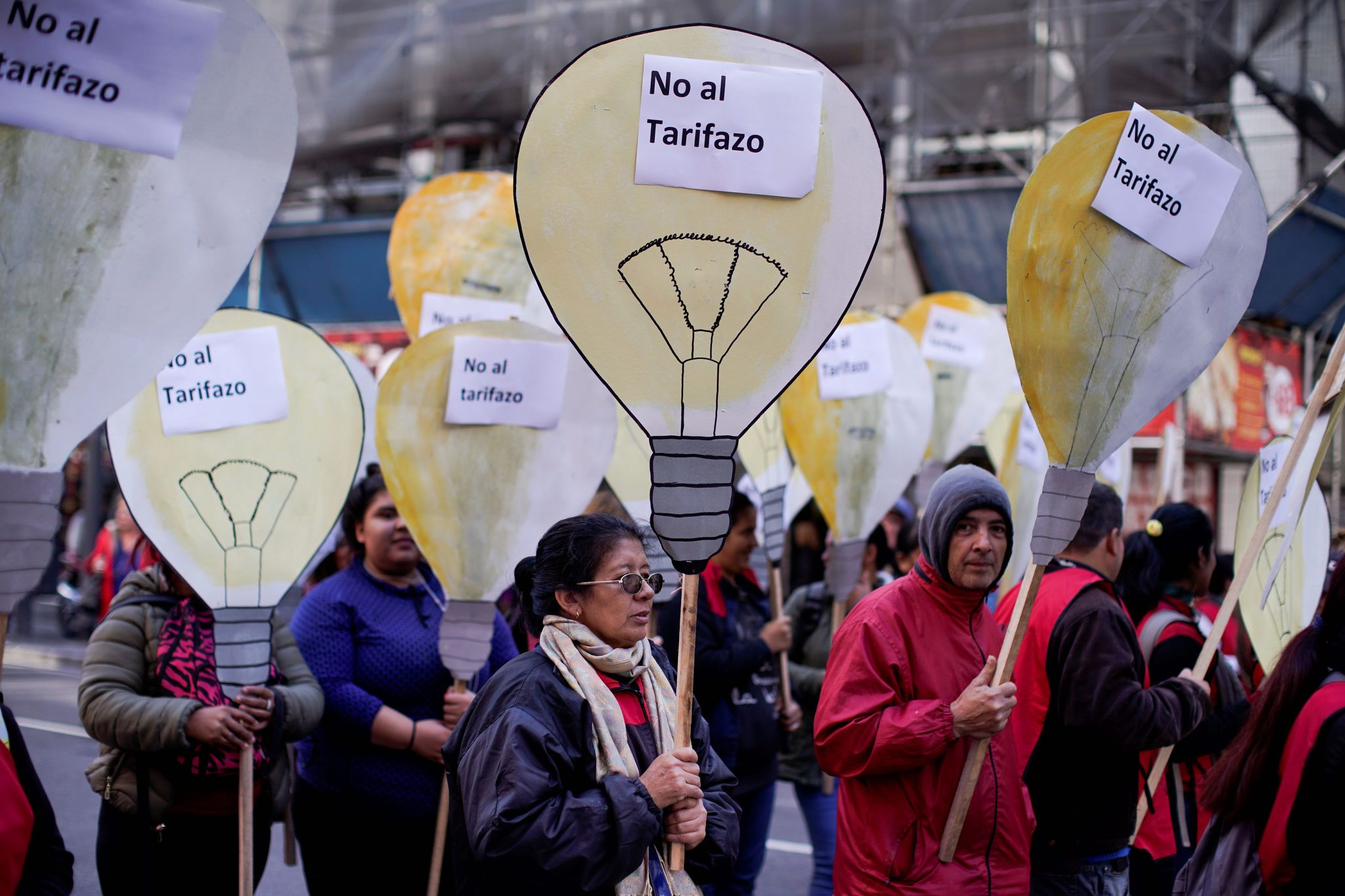
The return of the pesos bears and a sharp rise in the U.S. dollar have left Argentina — and a number of developing countries including Brazil, Mexico, South Africa and Russia — reeling again, desper
BUENOS AIRES — A shopping trip to Miami or a beach vacation in Brazil is far beyond Samuel Rivas’ budget. Nevertheless, the 57-year-old cabdriver was on a desperate hunt for foreign currency Wednesday in the Argentine capital’s financial district.
“It’s the only way I can make my money count — by buying dollars,” Mr. Rivas explained below the red digits flashing the Maguitur exchange office’s current values. “Because the day I want to trade in my car, if I saved in pesos, it’ll be totally devalued.”
His strategy — which has become a near-universal pastime in a country facing a 25 percent annual inflation rate and where everything including real estate and international airfare is priced in U.S. dollars — has turned into a crisis again in the past two weeks as the Argentine peso lost almost 18 percent of its value against the greenback.
The frustration on the streets is compounded because many Argentines thought they put such indignities in the rearview mirror with the election of center-right businessman Mauricio Macri as president in late 2015.
A 2001 government default was followed by 12 years of leftist rule that left Argentina struggling to rebuild its treasury and clean up its reputation in the global financial circle.
But the return of the currency bears and a sharp rise in the U.S. dollar have left Argentina — and a number of developing countries including Brazil, Mexico, South Africa and Russia — reeling again, desperately trying to bolster the value of their currencies without undermining local growth.
The issue has particular resonance here, with many Argentines talking of a “here we go again” feeling.
The dollar, worth just short of 21 pesos at the end of April, was selling this week for about 25 pesos. The decline was so steep that it unnerved locals long accustomed to the ever-weakening currency, which was once pegged to U.S. tender. On the day Mr. Macri was elected in December 2015, the dollar was worth barely over 9 pesos.
It also prompted a frenzied response from central bankers, who sought to prop up the peso by hiking interest rates by almost 13 points, to 40 percent, and by selling off some $9 billion in foreign currency reserves. The peso hit a historic low against the dollar on Monday, although there was faint sign it was firming up by Wednesday.
With a booming U.S. economy and the Federal Reserve raising interest rates, investor money that flooded into emerging markets such as Argentina is heading back to the U.S., putting huge pressure on countries that failed to prepare.
Carmen Reinhart, a Harvard economist specializing in international finance, turned heads this week when she told the Bloomberg News service that the emerging market economies are showing “more cracks now than they did five years ago and certainly at the time of the [2008] global financial crisis.”
Mr. Macri, under increasing pressure 15 months ahead of a likely re-election bid, has acknowledged the anxiety, though he was quick to declare that the “currency turbulence” had been overcome.
“Clearly, what happened this week is that the world has decided that the velocity at which we had committed to reducing the fiscal deficit is not enough,” Mr. Macri told reporters at the Olivos presidential residence on Wednesday. “So we’ll need to speed things up.”
The president, a onetime business associate of Donald Trump whose acumen with money was supposed to be one of his strongest assets, has called for a grand bargain with opposition leftist lawmakers, governors and union leaders to further rein in deficit spending, which he insisted was the source of all of Argentina’s financial troubles.
For all the efforts of Buenos Aires to set its house in order and restore its good credit, recent events have been a sharp reminder of the country’s vulnerability to trends and forces beyond its borders and beyond its control.
Vulnerable
“It’s a vulnerability because we depend on the world to lend us money, something we must change,” Mr. Macri said. “We Argentines have dragged along this problem, which weighs down all of society. So I believe it’s time to tell the truth: No more shortcuts, no more patches.”
Those words may well sound ominous to many overwhelmed Argentines who, in the wake of the administration’s cuts to government subsidies, have seen their utility bills and public transport costs triple or quadruple in a matter of months.
Mr. Macri’s May 8 decision to ask the International Monetary Fund for a $30 billion line of credit, ostensibly intended to inspire confidence, seems to have done just the opposite given Argentina’s troubled history with international lenders.
“It’s a sensitive topic [because] it reminds us … of somewhat traumatic experiences the country lived through,” said Mariano de Vedia, a political commentator for the La Nacion daily. “That doesn’t mean the [IMF] negotiations won’t be positive. But there’s an old saying: ‘He who scalded himself with milk cries when he sees a cow.’”
Popular unease is not enough of a reason to seek financing elsewhere, Mr. Macri insisted, especially because it could mean an additional $1 billion in interest per year.
“The [IMF] is a serious institution with which one makes good or bad deals; we’ll make a good deal,” Mr. Macri said. “We’re talking about hundreds of schools we can build, with the [savings] in interest, we’re talking about thousands of miles of freeway. … This must be a time of pragmatism.”
But to Emilio Massucco, who owns a small electronics store a few blocks from the Maguitur office, there is nothing pragmatic about looking to international powers that be to fix Argentina’s problems.
“I’d like for us to not depend on the dollar,” Mr. Massucco said while sitting in front of a rack adorned by a sizable Argentine flag. “I’d like for the country to be run in a way so as to not depend on the [IMF], of course, not depend on another country’s economy, especially that of the United States.”
While Mr. Macri praised his economic advisers Wednesday, the peso meltdown was affecting the wallets of bargain hunters along Florida Street, the busting Buenos Aires shopping mile where dozens of unlicensed money changers offer their services with their trademark, high-decibel cries of “Cambio, cambio.”
“You see it reflected in the value of a spare part of a cellphone, a tablet, whatever,” said Mr. Massucco, whose store sits inside the street’s Galeria Jardin electronics mall. “Buying from a wholesaler with a 30-day check means exacerbated dollar futures. … The dollar causes [price] hikes of all kinds.”
A day after the government gained some breathing room by avoiding a feared sell-off of short-term Lebac bonds, the 45-year-old entrepreneur’s confidence in official assurances that the worst is over was limited at best.
“The market has calmed down, and the Central Bank regulated things in some way,” Mr. Massucco said. “But even so, there still is latent instability and uncertainty.”
All but certain, though, is that the government’s annual inflation target of 15 percent — already boosted from the 10 percent estimate — has become wholly illusory. Unidentified officials warned this week that 20 percent and even 25 percent were more realistic objectives.
Amateur Milton Friedmans
The close link to inflation — and thus the costs of everyday products — is why ordinary Argentines keep a close eye on dollar values.
At the solidly named Sterling Cafe just five doors down from the Central Bank, Daniel Mendez Garcia sounded more like an economist than a coffee shop co-owner.
“You know what’s happening? You spend more. You have new price tags and old salaries,” Mr. Mendez said as he chatted with one of his regulars, a retired central banker. “Money in the street contracts, so there’s less in sales. It’s math; no need to be a guru [like] Milton Friedman.”
Unlike others, the 20-year coffee veteran insisted he won’t preemptively charge his customers more. But in a country with an $8 billion trade deficit, how much the peso is or isn’t worth will still make a difference.
“We only change the menu prices when they raise prices for me,” Mr. Mendez said. “[But] coffee will get more expensive now because it’s imported. There’s nothing you can do about it.”
In the meantime, halfhearted acknowledgments of errors — with Central Bank President Federico Sturzenegger conceding that markets were not “convinced” by his monetary policy and Mr. Macri faulting himself for being “too optimistic” — have done little to tame tempers.
“The self-criticism helps if you can gain something for the future,” Mr. Mendez said. “Otherwise, you can just commit hara-kiri.”
It’s advice Mr. Macri may want to heed if he wants to remain in office beyond October of next year, especially since voters have already shown an uncharacteristic amount of patience as they await his administration’s long-promised economic revival.
“In a way, [he] has been weakened; it just so happens that no other sector, party or candidate has tapped into this situation,” said Mr. de Vedia, the La Nacion analyst. “The [peso crisis] further delays the recovery, and that causes frustration and dissatisfaction.”
If any doubts remain as to just how present American legal tender is on Argentines’ minds, the president might do well do ditch his limousine and take a subway ride around Buenos Aires.
“Just 20 pesos,” a street vendor hawking ballpoint pens yelled on Wednesday in a crowded B line wagon: “If the dollar keeps rising on me, I don’t know for how much longer I’ll be able to sell them at 20 pesos.”
-
Nicolas Maduro-Mauricio Marci feud defines foreign relations
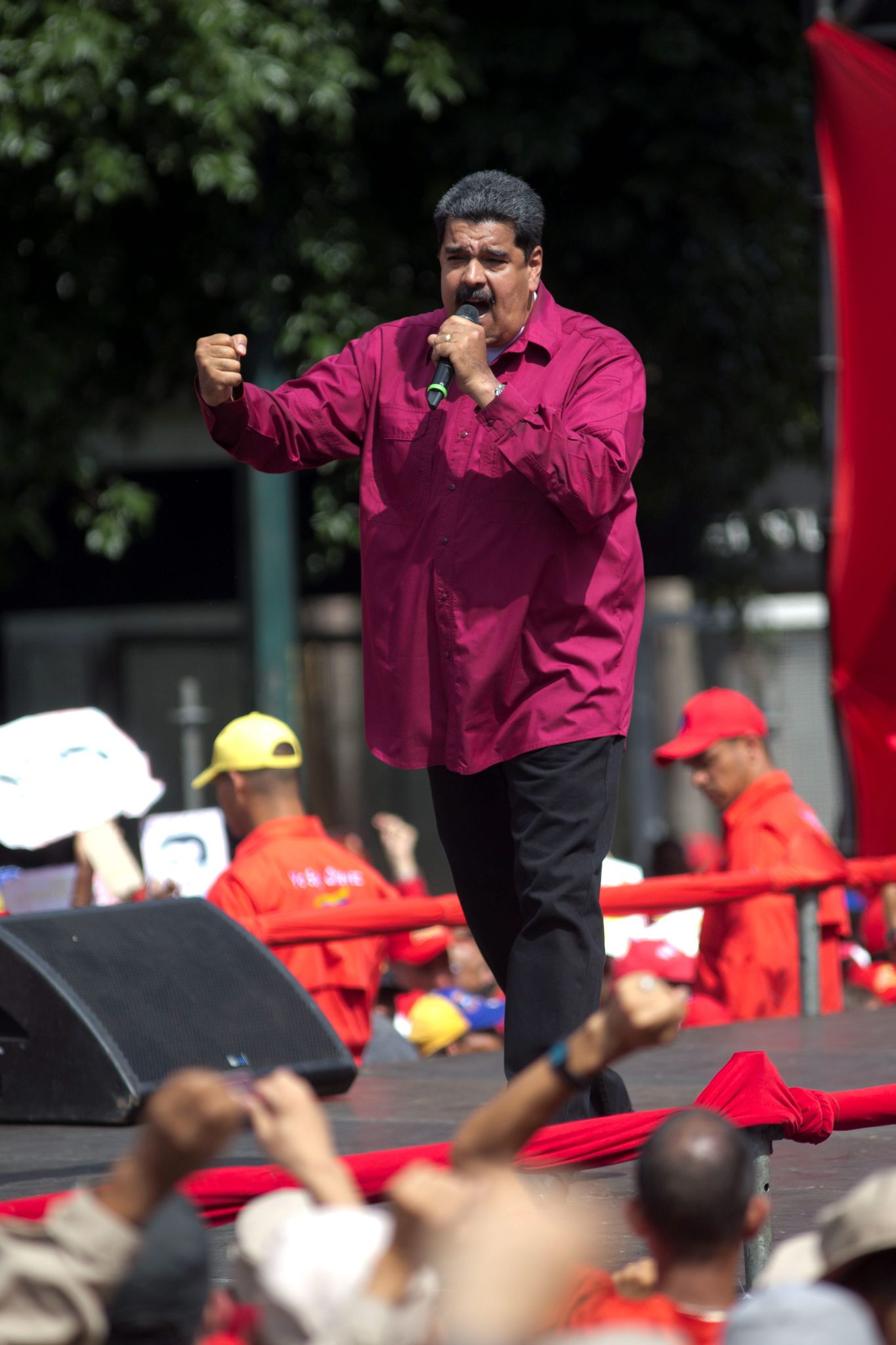
One is a former bus driver and union leader with a soft spot for Cuban-style fatigues and Cuban-style political authoritarianism. The other is a millionaire heir and soccer czar, a onetime business pa
Buenos Aires | One is a former bus driver and union leader with a soft spot for Cuban-style fatigues and Cuban-style political authoritarianism. The other is a millionaire heir and soccer czar, a onetime business partner of Donald Trump who favors suits from this city’s finest tailors and policies to lift up the country’s once-battered private sector.
And while they may share a title as presidents of their respective nations, the rift between Venezuela’s Nicolas Maduro and Argentina’s Mauricio Macri has never been greater, defining the ideological polarization that increasingly marks South American politics these days. With Brazil and Colombia in political limbo as they await national elections, the rebound of Mr. Macri and a number of center-right governments in South America is posing a direct challenge to the old-line leftism embodied by Mr. Maduro and his late predecessor and charismatic mentor, Hugo Chavez.
The ideological divide is matched by a personal animosity. Mr. Macri’s disdain for the embattled Mr. Maduro was on full display late last month when he all but called for his counterpart’s ouster, telling reporters he wants “what’s happening in Venezuela to come to an end.”
His comments came days after Argentina had announced it was joining Brazil, Chile, Colombia, Paraguay and Peru in pulling out of the Union of South American Nations, or UNASUR — a brainchild of Chavez.
The final straw — largely symbolic as the bloc had effectively lain dormant for years — seems to have been Caracas’ refusal to accept Argentine diplomat Jose Octavio Bordon, a Macri nominee, as its next secretary-general.
The volatile Mr. Maduro, facing a massive economic and demographic crisis at home as Venezuela’s oil-financed social welfare system nears collapse, meanwhile, characterized Mr. Macri and the region’s other center-right presidents as puppets of Washington.
“Some leaders of the right let themselves be pressured by the U.S. government to destroy UNASUR,” he said en route to a meeting with new Cuban President Miguel Diaz-Canel. “[If] some right-wing government tries to stab it and let it bleed to death, we social movement and revolutionaries of South America will defend it.”
Colorful as they may be, by Mr. Maduro’s standards, the comments were rather tame. In one of his infamous diatribes last year, Venezuela’s head of state had labeled Mr. Macri a “sewer rat” espousing to be the “godfather of the Venezuelan fascist right.”
Imitating Chavez
In lashing out, Mr. Maduro seeks to imitate his mentor Chavez, said veteran Venezuelan diplomat Oscar Hernandez Bernalette, though Mr. Maduro’s approval numbers lag his idol’s maximum popularity by some 40 percentage points.
“Maduro’s attitude is little more than a bad copy of Chavez’s attitude when Chavez had an audience, but he doesn’t have that same audience,” said Mr. Hernandez Bernalette. “His rhetoric likely reaches — and pleases the ears of — his closest collaborators and the few who back him.”
Most Venezuelans, though, are bewildered by the president’s crude rhetoric and intemperate attacks, said Mr. Hernandez Bernalette, now a prominent columnist for the El Nacional newspaper.
“Mr. Maduro’s reaction always is to insult, to attack whatever president’s turn it is — in this case Macri,” he said. “Venezuelans overall are mortified every time the head of state, of whom one expects the highest levels of conduct, [does that].”
But beyond personal grudges, Mr. Macri is carving out a role for himself as champion a more pragmatic, conservative South America that is not instinctively hostile to the private sector, said Gustavo Cardozo, an analyst at the Argentine Center of International Studies in Buenos Aires.
“He [wants to] focus on trade relations untainted by the kind of extremist ideology the Maduro regime has laid out,” he said. “Maduro constantly attacks Europe and the United States, which are very important markets. Logically, you can’t be in sync with a regime that turns its back on international trade.”
Mr. Macri’s domestic critics, meanwhile, see a conspiracy to reverse South American integration behind the UNASUR exit, as well as behind last year’s suspension of Venezuela from the Mercosur trade bloc.
“All that was halted to return our country to the great powers’ axis of dependency,” said Alicia Castro, an Argentine ambassador to Venezuela under Mr. Kirchner and Ms. Fernandez. “The goal is very clear: to destroy our region’s economies.”
“It’s regrettable that Argentina is aligning itself with Trump to harass and hit Venezuela,” she said. “In Venezuela, there is no ‘interruption of the democratic order’ — that’s Washington propaganda Macri repeats like a parrot.”
With the rhetoric showing no signs of cooling, though, the next showdown between South America’s rival presidents is already under way, as Mr. Maduro’s plan to hold early presidential elections on May 20 — over the objections of the Venezuelan opposition parties — did not come without commentary from Buenos Aires.
“We won’t accept the results because that election doesn’t have any validity, however much Mr. Maduro insults me,” Mr. Macri warned last month. “We won’t recognize [him] as a democratic president because there hasn’t been any democracy in Venezuela for quite a while.”
“Who is Macri to determine what happens in Venezuela?” Mr. Maduro, predictably, shot back. “A dummy of imperialism.”