Tag: Seoul

  • Kim Jong-un, Moon Jae-in join hands on peak of sacred North Korean volcano

    The leaders of the rival Koreas took to the road for the final day of their summit Thursday, standing on the peak of a beautiful volcano considered sacred in the North and a centerpiece of propaganda

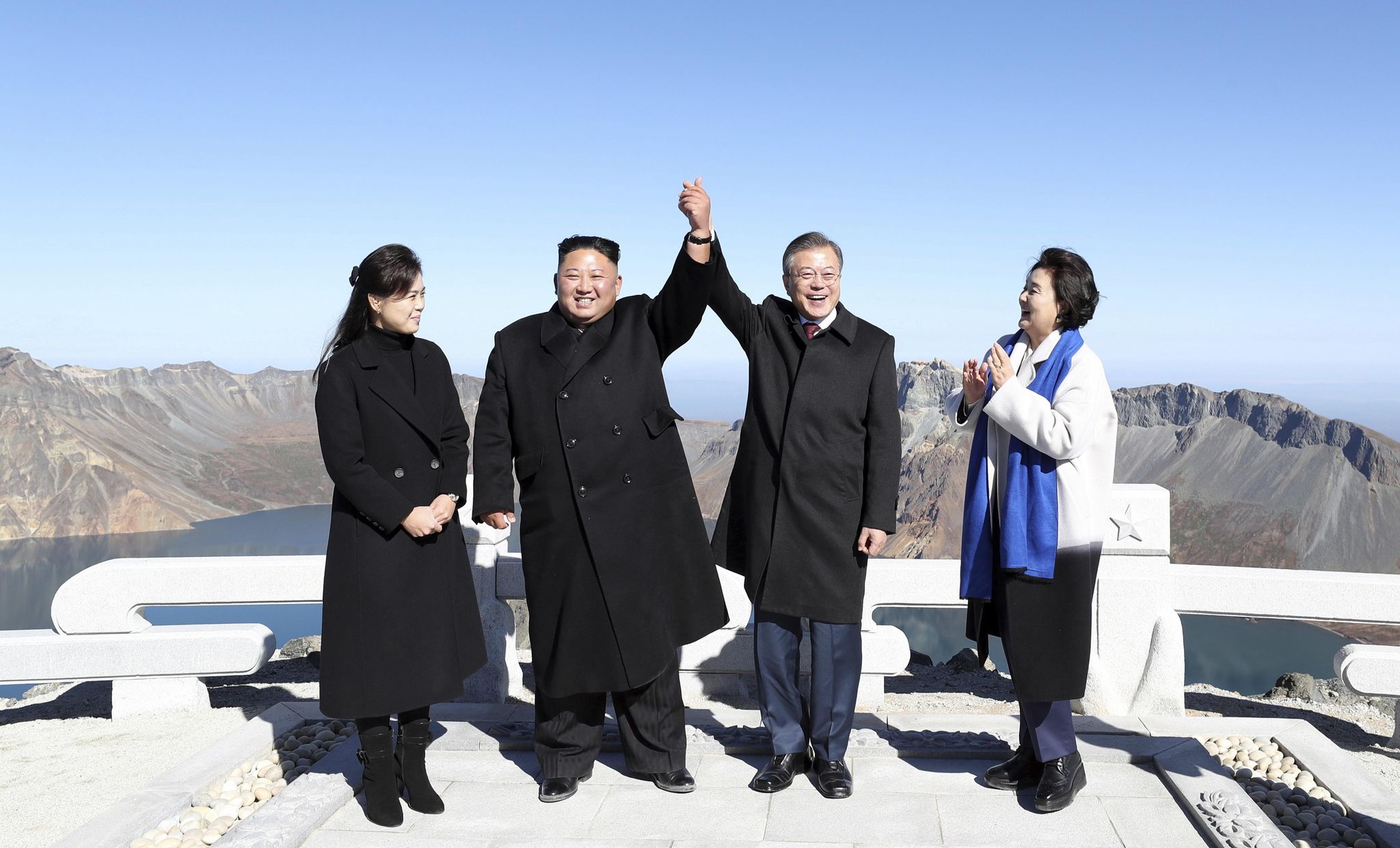
    PYONGYANG, North Korea (AP) — The leaders of the rival Koreas took to the road for the final day of their summit Thursday, standing on the peak of a beautiful volcano considered sacred in the North and a centerpiece of propaganda used to legitimize the Kim family’s rule, their hands clasped and raised in a pose of triumph. Their trip to the mountain on the North Korean-Chinese border, and the striking photo-op that will resonate in both Koreas, followed a day of wide-ranging agreements they trumpeted as a major step toward peace.

    However, their premier accord on the issue that most worries the world — the North’s pursuit of nuclear-tipped missiles that can accurately strike the U.S. mainland — contained a big condition: Kim Jong-un stated that he would permanently dismantle North Korea’s main nuclear facility only if the United States takes unspecified corresponding measures.

    Kim and South Korean President Moon Jae-in flew separately to an airport near Mount Paektu on Thursday morning where they then met up and drove to the mountain.

    Photos showed the leaders smiling broadly as they posed at the summit, their wives grinning at their sides, a brilliant blue sky and the deep crater lake that tops the volcano in the background; they also toured the shores of the lake. Members of the Kim family are referred to as sharing the “Paektu Bloodline,” and the volcano is emblazoned on the national emblem and lends its name to everything from rockets to power stations.

    Many South Koreans also feel drawn to the volcano, which, according to Korean mythology was the birthplace of Dangun, the founder of the first ancient Korean kingdom, and has long been considered one of the most beautiful places on the peninsula. Not everyone was pleased, though. About 100 anti-North Korea protesters rallied in central Seoul to express anger about the summit and displayed slogans that read, “No to SK-NK summit that benefits Kim Jong Un.”

    Moon arrived in South Korea later Thursday and was expected to brief the media.

    The leaders are basking in the glow of the joint statement they settled Wednesday. Compared to the vague language of their two earlier summits, Kim and Moon seem to have agreed on an ambitious program meant to tackle soaring tensions last year that had many fearing war as the North tested a string of increasingly powerful weapons.

    Kim promised to accept international inspectors to monitor the closing of a key missile test site and launch pad and to visit Seoul soon, and both leaders vowed to work together to try to host the Summer Olympics in 2032.

    But while containing several tantalizing offers, their joint statement appeared to fall short of the major steps many in Washington have been looking for – such as a commitment by Kim to provide a list of North Korea’s nuclear facilities, a solid step-by-step timeline for closing them down, or an agreement to allow international inspectors to assess progress or discover violations.

    It also was unclear what “corresponding steps” North Korea wants from the U.S. to dismantle its nuclear site.

    The question is whether it will be enough for President Donald Trump to pick up where Moon has left off. Trump told reporters Wednesday that the outcome of the summit was “very good news” and that “we’re making tremendous progress” with North Korea. He didn’t indicate in his brief remarks whether the U.S. would be willing to take further steps to encourage North Korean action on denuclearization.

    Declaring they had made a major step toward peace, Moon and Kim stood side by side Wednesday as they announced their agreement.

    “We have agreed to make the Korean Peninsula a land of peace that is free from nuclear weapons and nuclear threat,” Kim said. “The road to our future will not always be smooth and we may face challenges and trials we can’t anticipate. But we aren’t afraid of headwinds because our strength will grow as we overcome each trial based on the strength of our nation.”

    Moon urged unity for all Koreans in a speech he gave Wednesday night to the crowd gathered for North Korea’s signature mass games. “We have lived together for 5,000 years and lived in separation for 70 years. I now propose that we completely eliminate the hostility of the past 70 years and take a big step forward in peace so that we can become one again.”

    Historians say the 5,000-year timeline of Korean history is a groundless claim that became part of South Korea’s official narrative after being inserted in school textbooks during the rule of former dictator Chun Doo-hwan.

    This week’s summit comes as Moon is under increasing pressure from Washington to find a path forward in efforts to get Kim to completely – and unilaterally – abandon his nuclear arsenal.

    Trump has maintained that he and Kim have a solid relationship, and both leaders have expressed interest in a follow-up summit to their meeting in June in Singapore. North Korea has been demanding a declaration formally ending the Korean War, which was stopped in 1953 by a cease-fire, but neither leader mentioned it Wednesday as they read the joint statement.

    In the meantime, however, Moon and Kim made concrete moves of their own to reduce tensions on their border.

    According to a statement signed by the countries’ defense chiefs, the two Koreas agreed to establish buffer zones along their land and sea borders to reduce military tensions and prevent accidental clashes. They also agreed to withdraw 11 guard posts from the Demilitarized Zone by December and to establish a no-fly zone above the military demarcation line that bisects the two Koreas that will apply to planes, helicopters and drones.

    Other agreements aimed at removing some longstanding irritants from their relations, such as allowing more contact between families divided by the Korean War. Moon also appeared to be making good on his proposals to help build up the North’s infrastructure and open cross-border rail links.

    ___

    Klug reported from Seoul. Associated Press writers Hyung-jin Kim and Kim Tong-hyung in Seoul contributed to this report.
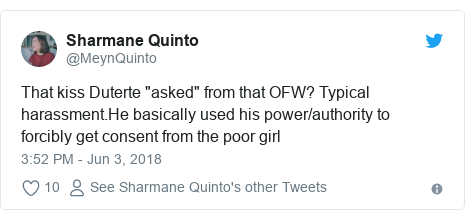
  • Philippine President Duterte condemned for kissing overseas employee

    Symbol Copyright @MeynQuinto @MeynQuinto Image Copyright @kyleeelilipop @kyleeelilipop


    ‘Strong, assertive image’

    Howard Johnson, BBC Philippines reporter

    Despite a string of accusations of misogyny in opposition to the president, he remains popular each in the Philippines and with Overseas Filipino Staff (OFW).

    OFWs I Have spoken with say they like Mr Duterte as a result of he projects a powerful, assertive symbol of the Philippines; a father determine to appear after the rustic and its kids even as they are working abroad.

    On a recent shuttle to the uk, I met a Filipino nurse running in a sanatorium in London. She mentioned she idea the Western media have been biased in opposition to the president and did not report information approximately him accurately.

    Critics of the federal government say that many OFWs are targeted via pro-government bloggers on social media feeds. they say postings on systems like Facebook and Twitter spin an erroneous, glowing image of the president.

    (more…)

  • The Latest: Trump’s claim of no nuke threat seen as dubious

    The Latest on the summit between President Donald Trump and North Korean leader Kim Jong Un (all times local):

    WASHINGTON (AP) – The Latest on the summit between President Donald Trump and North Korean leader Kim Jong Un (all times local):

    11:30 a.m.

    Secretary of State Mike Pompeo says he’s confident that U.S. talks with North Korea will resume “sometime in the next week.”

    Pompeo says he doesn’t know the exact timing. Speaking in Seoul, he says he expects it to happen fairly quickly after he and the North Koreans return to their nations. Pompeo returns late Thursday to the U.S.

    He says President Donald Trump is “in the lead” but that “I will be the person who takes the role of driving this process forward.”

    He says much more work has been done by the U.S. and North Korean that couldn’t be encapsulated in the Trump-Kim Jong Un statement. So he says teams will now work to make more progress on those items.

    ___

    11:20 a.m.

    Secretary of State Mike Pompeo says the United States wants North Korea to take major nuclear disarmament steps within the next two years.

    Pompeo is laying out an ambitious timeline for denuclearization following President Donald Trump’s meeting with Kim Jong Un. He says he won’t disclose specific timelines but that the administration is hopeful that “major, major disarmament” steps can occur before the end of Trump’s first term. The term ends in January 2021.

    Pompeo is also urging skepticism after North Korean official media said Trump had agreed to a step-by-step approach to denuclearization. Pompeo isn’t being specific but says that “one should heavily discount some things that are written in other places.”

    Pompeo spoke to reporters from Seoul, South Korea.

    ___

    11:15 a.m.

    Secretary of State Mike Pompeo says that North Korean leader Kim Jong Un understands that “there will be in-depth verification” of nuclear commitments in any deal with the U.S.

    Pompeo is pushing back on criticism that the joint agreement signed by Kim and President Donald Trump includes no mention of verifying North Korean nuclear disarmament. Ahead of Trump’s summit with Kim, the U.S. had said disarmament must be “complete, verifiable and irreversible.”

    But Pompeo tells reporters that it’s silly to focus on the lack of the word “verifiable.” He says that’s because the agreement does refer to “complete” denuclearization of the Korean Peninsula. Pompeo says that “in the minds of everyone concerned,” the word “complete” encompasses “verifiable.”

    Pompeo says: “I am equally confident they understand that there will be in-depth verification.”

    ___

    11:10 a.m.

    Secretary of State Mike Pompeo says joint U.S.-South Korea military exercises will resume if North Korea stops negotiating in good faith over its nuclear program.

    Pompeo is in South Korea a day after President Donald Trump met with Kim Jong Un and announced the U.S. would freeze what he called “war games” with North Korea.

    Pompeo says he was there when Trump talked about it with Kim. He says Trump “made very clear” that the condition for the freeze was that good-faith talks continue. He says if the U.S. concludes they no longer are in good faith, the freeze “will no longer be in effect.”

    Pompeo says Trump was “unambiguous” in conveying that to Kim.

    ___

    11 a.m.

    House Speaker Paul Ryan says President Donald Trump should be “applauded” for his meeting with North Korea leader Kim Jong Un. But Ryan is cautioning on Wednesday that the next steps toward an agreement won’t go fast.

    The Wisconsin Republican, who is retiring this year, told reporters that “The president needed to disrupt the status quo, and the president has disrupted the status quo” with the historic meeting in Singapore. He said “the president should be applauded….Now let’s go get an agreement.”

    Trump and Kim signed a joint statement that contained a repeat of past promises to work toward a denuclearized Korean Peninsula, but the details haven’t been nailed down.

    He cautioned that no one should expect that process to go quickly. “Time,” he said, “will tell how this ends.”

    ___

    10 a.m.

    President Donald Trump is challenging skeptical media coverage of his historic summit with North Korea’s Kim Jong Un. He says “Fake News” is the nation’s “biggest enemy.”

    Trump writes on Twitter that “the Fake News, especially NBC and CNN” are “fighting hard to downplay the deal with North Korea.”

    Trump says that “500 days ago they would have ‘begged’ for this deal-looked like war would break out.”

    The president says the country’s “biggest enemy is the Fake News so easily promulgated by fools!”

    Trump has been tweeting about his talks with Kim since Air Force One returned to the United States early Wednesday morning, arguing that the talks with North Korea have made the U.S. safer. Trump’s claim is dubious considering Pyongyang’s significant weapons arsenal.

    ___

    7:25 a.m.

    President Donald Trump is defending his calls to end military exercises with South Korea that allies have said is important to security in the Asia Pacific region.

    Trump says on Twitter after returning from his Singapore summit that “we save a fortune by not doing war games, as long as we are negotiating in good faith.”

    Trump has said the U.S. and South Korea should stop their joint military exercises as long as both sides are negotiating in good faith, which the president says is happening.

    Back in the United States, Trump is tweeting about his historic summit with North Korean leader Kim Jong Un. He says there is no longer a nuclear threat from North Korea even though experts estimate that Kim’s government has enough fissile material for 20 to 60 bombs.

    __

    6:15 a.m.

    President Donald Trump says on Twitter, “There is no longer a Nuclear Threat from North Korea,” as he returns to the United States after his historic summit with North Korea leader Kim Jong Un.

    Trump says on Twitter that “everybody can now feel much safer than the day I took office.”

    He says before he took office, “people were assuming that we were going to War with North Korea,” and President Barack Obama said North Korea was the nation’s biggest problem.

    Trump and Kim signed an agreement to work toward denuclearization, but it appears weaker than past deals that failed. Independent experts estimate North Korea now has enough fissile material for 20 to 60 bombs, and it has tested missiles that could potentially deliver a nuclear weapon to the U.S. mainland.

    ___

    5:37 a.m.

    President Donald Trump has arrived back in Washington from his historic nuclear summit with North Korea’s Kim Jong Un in Singapore.

    Air Force One touched down at Joint Base Andrews early Wednesday morning, completing the president’s marathon trip to Asia for talks with the North Korean leader. The president made refueling stops in Guam and Hawaii on his return to Washington.

    While his aircraft refueled in Hawaii, Trump thanked Kim for “taking the first bold step toward a bright new future for his people,” saying their summit on Tuesday “proves that real change is possible!”

    During his return, Trump spoke with South Korean Prime Minister Moon Jae-in and Japanese Prime Minister Shinzo Abe.

    ___

    6:25 p.m.

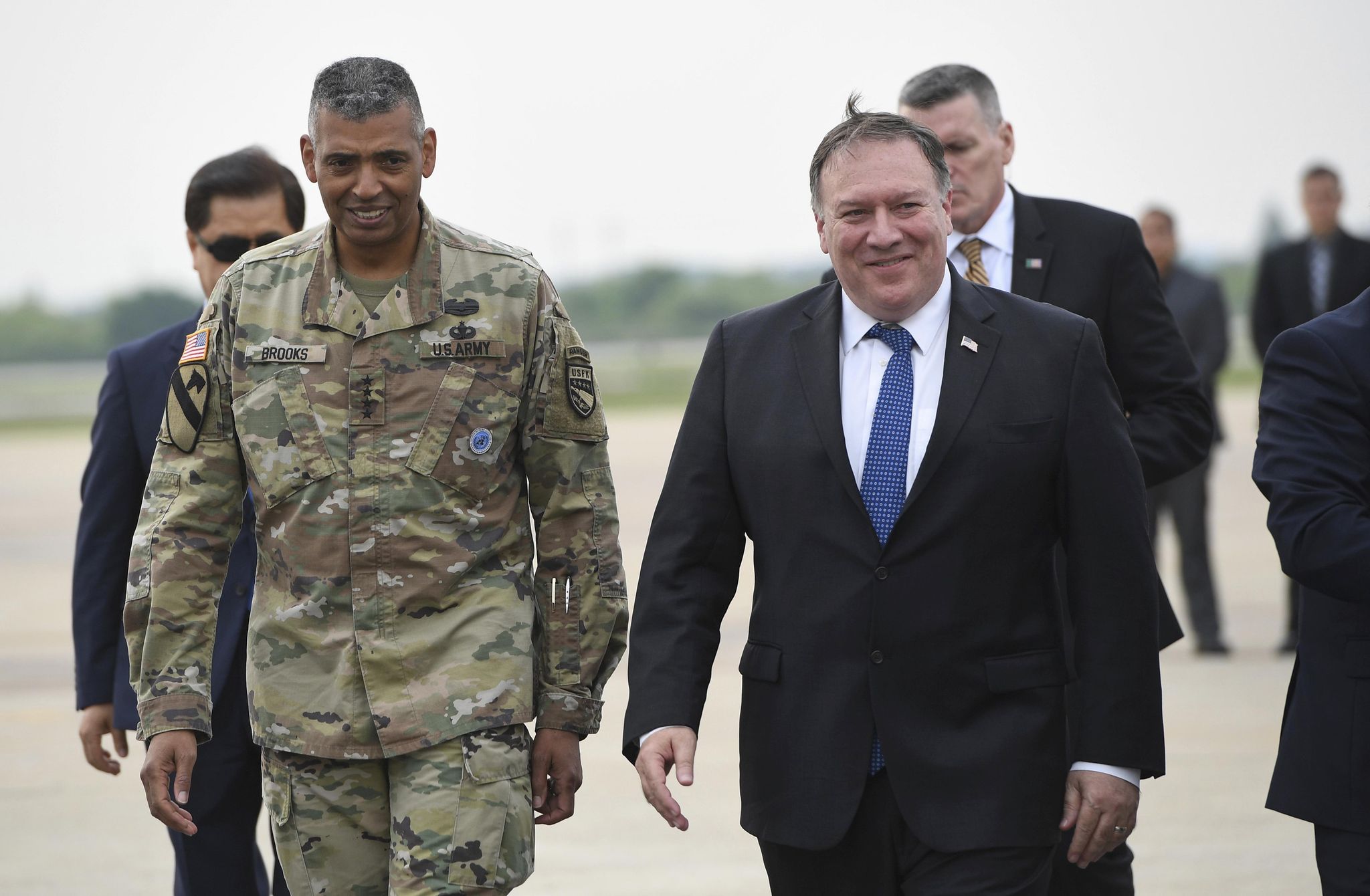
    U.S. Secretary of State Mike Pompeo has landed at Osan Air Base south of Seoul ahead of meetings with America’s allies in the aftermath of the summit between President Donald Trump and North Korean leader Kim Jong Un.

    He’s expected to meet privately in the evening with Gen. Vincent Brooks, commander of U.S. Forces Korea.

    Pompeo will meet President Moon Jae-in on Thursday morning to discuss the summit.

    Japanese Foreign Minister Taro Kono is also heading to Seoul and is due to meet with Pompeo and his South Korean counterpart. Pompeo, the former CIA director, then plans to fly to Beijing to update the Chinese government on the talks.

    ___

    5:05 p.m.

    Russia is welcoming the outcome of the summit between President Donald Trump and North Korean leader Kim Jong Un.

    Kremlin spokesman Dmitry Peskov says “one can only welcome the fact that such a meeting took place and that direct dialogue was begun.”

    Peskov tells reporters in Moscow on Wednesday that the meeting helps de-escalate tensions and push the situation away “from the critical point where it was just a few months ago.”

    Peskov says the meeting confirms Russian President Vladimir Putin’s view that “there is no alternative to political and diplomatic means in solving the problem of the Korean Peninsula.”

    Peskov adds, however, that given how complicated the situation is around North Korea, the Kremlin isn’t expecting a quick resolution.

    ___

    3:20 p.m.

    A spokesman of South Korean President Moon Jae-in says Washington and Seoul need to consider a “variety of ways to further facilitate dialogue” while they are engaged in nuclear negotiations with Pyongyang.

    Kim Eui-kyeom made the comments on Wednesday when asked to respond to President Donald Trump, who following his summit with North Korean leader Kim Jong Un said that the United States and South Korea should stop their joint military exercises “as long as we are negotiating in good faith.”

    Kim, Moon’s spokesman, says Seoul is still trying to figure out the exact meaning and intent of Trump’s comments.

    ___

    10:50 a.m.

    The U.S. top diplomat is jetting to South Korea to brief the country’s president as Asian allies try to parse the implications of the extraordinary nuclear summit in Singapore between President Donald Trump and North Korea’s Kim Jong Un.

    South Korea’s presidential office says U.S. Secretary of State Mike Pompeo will meet President Moon Jae-in Thursday morning to discuss the meeting, which made history as the first between sitting leaders of the U.S. and North Korea.

    Trump and Kim reached a broad agreement that offered few specifics but included promises of U.S. security guarantees and a reiteration from Kim of his country’s commitment to “complete denuclearization of the Korean Peninsula.”

    Trump however seems to have caught allies off guard by saying he would stop U.S.-South Korean war games.

  • Kim Jong-un, Moon Jae-in meeting failure could scuttle Trump summit

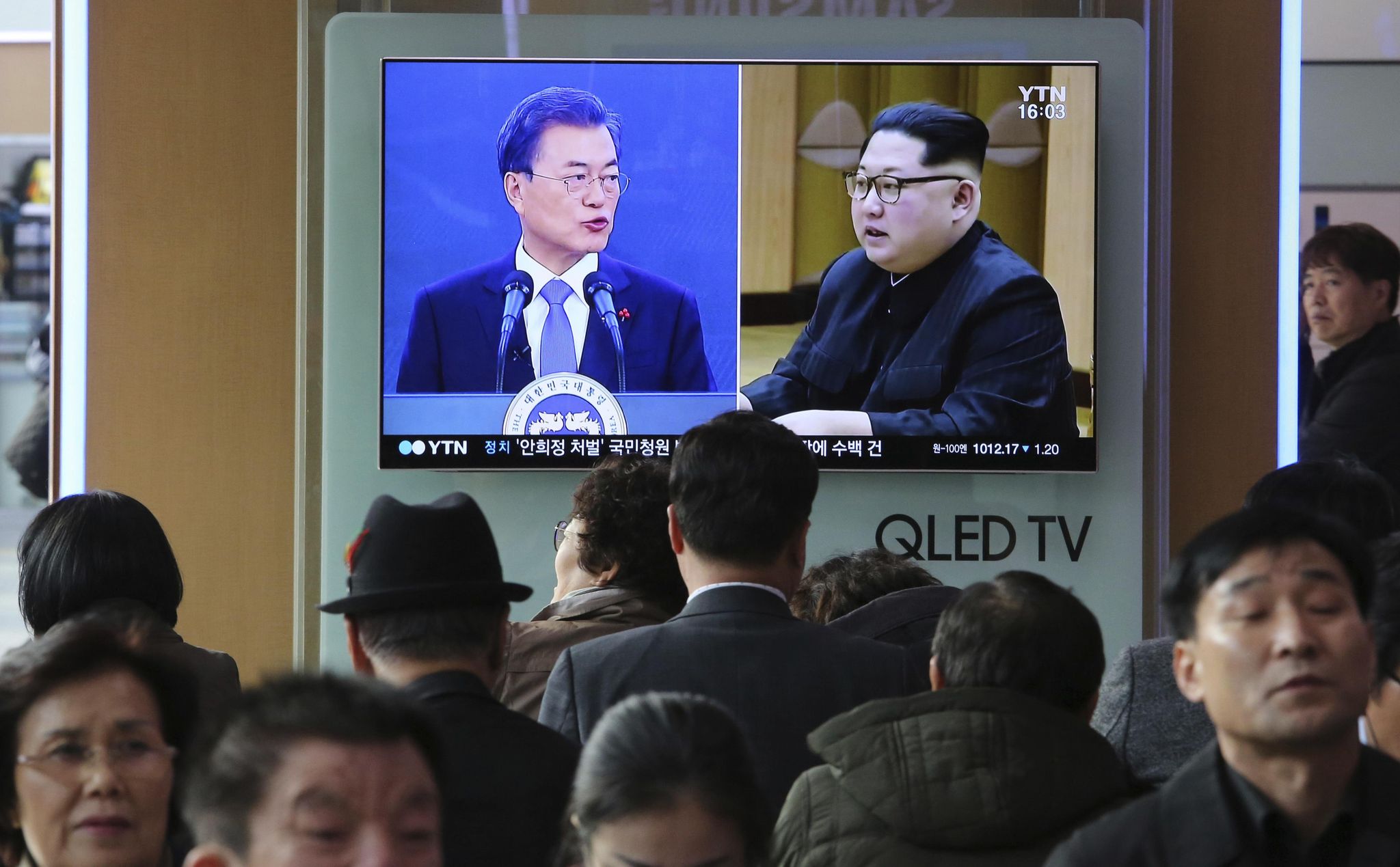
    The prospect for a historic summit between President Trump and Kim Jong-un is rising, but it won’t happen if things don’t go smoothly Friday when the North Korean leader first meets with South Korean

    SEOUL — The prospect for a historic summit between President Trump and Kim Jong-un is rising, but it won’t happen if things don’t go smoothly Friday when the North Korean leader first meets with South Korean President Moon Jae-in for their own high-stakes one-on-one meeting.

    North Korea says it is ready to halt testing of its nuclear weapons programs indefinitely, but Mr. Moon is still under immense pressure to get Mr. Kim to publicly declare that he is willing to discuss total abandonment and dismantling of the weapons he already has. Washington has drawn the red line for serious talks toward sanctions relief to proceed.

    South Korean officials said Mr. Kim signaled such willingness to them during a private meeting last month, but the North Korean leader hasn’t said anything in public.

    “So President Moon knows that if he cannot get some kind of denuclearization statement from Kim on April 27, people will consider the summit a failure,” said Joonhyung Kim, a regional geopolitics researcher at South Korea’s Handong University who is part of a circle of analysts advising the Moon administration.

    “We need to hear it from Kim Jong-un’s mouth,” Mr. Kim told The Washington Times.

    The likelihood of a Trump-Kim summit even without a clear denuclearization statement from Mr. Kim seemed to get a boost with the revelation last week that CIA Director Mike Pompeo held a secret meeting with the North Korean leader in Pyongyang early this month.

    But concern over the issue has persisted amid Pyongyang’s claim that it is willing to scrap a major nuclear test site and indefinitely halt nuclear and missile tests because it is confident it has achieved its goal of developing a nuclear arsenal that can ward off attacks and ensure the survival of the regime.

    Denuclearization is just one of the major issues looming over the Moon-Kim summit Friday in the village of Panmunjom, along the heavily guarded Demilitarized Zone that has divided the Korean Peninsula since the armistice that ended the 1950-1953 hostilities.

    Another major question centers on the extent to which Mr. Moon makes promises to the North that diverge from views of hard-liners in the Trump administration. Such promises could relate to Pyongyang’s desired retention of intercontinental ballistic missiles or the speed at which the Kim regime can expect relief from crippling international sanctions.

    Mr. Moon, who has long advocated a policy of outreach to Pyongyang, may simply seek to keep talks alive with the North, regardless of pressure from Washington.

    Where the Trump administration is seen to desire an “all-or-nothing deal” that can be reached quickly, many here say Mr. Moon is committed to a slower approach — one that has denuclearization as a goal to be achieved over a significant time frame.

    One senior official, who spoke on the condition of anonymity, said Mr. Moon’s advisers are confident that they have persuaded the Trump administration to go along with this “very gradual approach that will eventually lead to reaching our collective goal of denuclearization.”

    The official said the “situation is complex,” with Mr. Moon playing the delicate role of “mediator between Trump and Kim.”

    Mr. Moon’s conservative critics here fear that the South Korean president may be overconfident and risk losing Washington’s trust by yielding too eagerly to Pyongyang. “I wouldn’t be surprised if some of these [expletives] in the Moon administration are talking more to the North Koreans than they are to the Americans at this point,” one former high-level official told The Times.

    But most South Korean analysts say Mr. Moon knows what’s at stake.

    “President Moon is going to be trying with maximum effort to persuade Kim Jong-un to keep his commitment to denuclearize and to not step back from the commitment he already made in private to a special delegation that went to Pyongyang,” said Paik Hak-soon, a top North Korea specialist with the Sejong Institute think tank outside Seoul.

    But Mr. Paik said a range of other issues will likely be discussed Friday, including a push to set clear guidelines for regular high-level military-to-military communications between North and South, with the goal of avoiding a clash should the diplomatic push melt down.

    ‘Anything is possible’

    Mr. Paik said he is confident that the Moon-Kim summit could set the stage for a major and swift breakthrough in the subsequent Trump-Kim summit, especially because it won’t be mired by the presence of other regional powers.

    The last major attempt at diplomacy with North Korea — the yearslong “six-party talks” that melted down in 2009 — involved high-level representatives from China, Russia, the U.S., Japan and South Korea.

    “This bilateral format this time around, coupled with the timing of this U.S.-North Korea summit taking place at a quite early stage of the Trump administration’s tenure, and also the Trump administration’s special leadership style, could give both sides a lot of confidence in making a deal,” said Mr. Paik. “Anything is possible in this format if the personal chemistry is there.

    “Getting Trump and Kim alone together gives an incentive to both sides,” he said. “Donald Trump thinks that in a bilateral format he can exercise whatever power he has to induce Kim Jong-un to make concessions, and Kim Jong-un might be in the same position, thinking he can talk to American leadership directly and put all the key issues on the table and do a comprehensive package deal.”

    The bilateral approach also leaves China and Japan on the outside looking in, which some here argue has been Mr. Moon’s strategy all along. “I was advising Moon on foreign policy in last year’s election,” said Mr. Kim, the geopolitics researcher at Handong University. “The idea is that the smaller the number of players the better.”

    Jun Bong-geun, who oversees security and unification studies at the Korea National Diplomatic Academy in Seoul, suggested that even if North Korea is only posturing in the talks, Mr. Kim will have to commit quickly to something in a one-on-one setting with Mr. Trump.

    “If the North Koreans want to truly buy time, they’re going to have to come up with some kind of denuclearization measures,” said Mr. Jun, although he added that he won’t be surprised if Pyongyang first makes an offer to get rid of its ballistic missiles as a way to delay a serious confrontation on the nuclear issue.

    Others warn against believing in anything that the North Koreans bring to the table.

    “I have experience dealing with them, and I know they are not simply going to get rid of their nuclear weapons,” said Kim Hee-sang of the Korea Institute for National Security Affairs think tank in Seoul.

    ‘Missed chance’

    A former longtime adviser to the South Korean government, Mr. Kim told The Times that “the simple reality is that the North Koreans will be disingenuous throughout these upcoming summits.”

    He added that North Korea’s leader may offer to break up his nuclear program but said the offer will be superficial and that Pyongyang will make it known that pieces of the program can be hidden and restarted in the future.

    On a separate front, Mr. Kim expressed concern that Mr. Moon may be planning to offer the North Korean leader something well beyond the American comfort level regarding the size or positioning of U.S. forces stationed in South Korea.

    Pyongyang has long asserted that it would consider denuclearization only in conjunction with the departure of the 30,000 U.S. forces deployed to the South since the Korean War ended in a stalemate.

    Although the Moon administration claimed to have received back-channel assurances that Pyongyang is willing to drop the demand for troop withdrawal, Mr. Kim said there is reason for concern.

    “I don’t think Moon will make promises that cannot be kept, but I am concerned because everyone knows that when it comes to serious peace negotiations on the Korean Peninsula, the [troops] issue always arises,” he said. “There should never be a case where the U.S. military leaves South Korea.”

    Mr. Kim added flatly that whatever happens with the upcoming talks, the long-term policy toward North Korea should be some form of regime change.

    Mr. Kim lamented that the downside of the push for peaceful negotiations is that it has given a hue of legitimacy to the regime in Pyongyang and, as a result, pushed the “regime change issue off the table.”

    “The Trump administration has made an effective outcome here so far by making North Korea think they are in a very severe and desperate situation and that they have no choice but to try talking,” he said. “But when Trump brought about the ‘maximum pressure’ campaign of the past year, there was a chance to bring about regime change in Pyongyang.

    “Right now,” he said, “we’ve missed that chance.”